.jpg?width=480) Ka-52Attack and reconnaissance helicopterSide: RussiaBuilt: Kamov, Progress Arsenyev Aviation Company, Russian Helicopters / RussiaThe Ka-52 is a Russian two-seat attack and reconnaissance helicopter derived from the Ka-50 and built around a coaxial rotor layout, side-by-side crew cockpit, 30 mm cannon, and guided-missile hardpoints. In the Russia-Ukraine War it became one of Russia's most visible rotary-wing strike platforms, especially in southern Ukraine where Ka-52 and Ka-52M crews used longer-range anti-tank missiles against Ukrainian ground forces.
Ka-52Attack and reconnaissance helicopterSide: RussiaBuilt: Kamov, Progress Arsenyev Aviation Company, Russian Helicopters / RussiaThe Ka-52 is a Russian two-seat attack and reconnaissance helicopter derived from the Ka-50 and built around a coaxial rotor layout, side-by-side crew cockpit, 30 mm cannon, and guided-missile hardpoints. In the Russia-Ukraine War it became one of Russia's most visible rotary-wing strike platforms, especially in southern Ukraine where Ka-52 and Ka-52M crews used longer-range anti-tank missiles against Ukrainian ground forces.Tag archive
anti-tank Weapon Systems
Weapon systems and military equipment tagged anti-tank.
35 weapon systemsCategory
Aircraft & UAVs
Crewed aircraft, drones, and loitering munitions.
Ka-52Attack and reconnaissance helicopterSide: RussiaBuilt: Kamov, Progress Arsenyev Aviation Company, Russian Helicopters / RussiaThe Ka-52 is a Russian two-seat attack and reconnaissance helicopter derived from the Ka-50 and built around a coaxial rotor layout, side-by-side crew cockpit, 30 mm cannon, and guided-missile hardpoints. In the Russia-Ukraine War it became one of Russia's most visible rotary-wing strike platforms, especially in southern Ukraine where Ka-52 and Ka-52M crews used longer-range anti-tank missiles against Ukrainian ground forces. Mi-28Attack helicopterSide: RussiaBuilt: Mil Moscow Helicopter Plant / Rostvertol / RussiaThe Mi-28 Havoc is a Russian two-seat attack helicopter developed for anti-armor, close air support, and armed reconnaissance missions. Modern Mi-28N/NM-family aircraft combine armored tandem cockpits, a 30 mm chin cannon, guided missiles, rockets, and day/night sensors; Russian forces have used the type in the Russia-Ukraine War, where helicopters have faced dense ground-based air-defense and drone threats.
 Mi-24/Mi-35Attack helicopter and armed assault transportSide: UkraineBuilt: Mil Moscow Helicopter Plant / Rostvertol / Soviet Union / RussiaThe Mi-24/Mi-35 Hind family combines an armored attack helicopter with limited troop-carrying capacity, giving operators a platform for close air support, anti-armor fires, and armed escort. In the Russia-Ukraine War, Ukraine has used legacy and donated Mi-24V/Mi-35 airframes for low-level rocket attacks and adapted some Hinds to carry Western unguided rockets.
Category
Armored Vehicles
Troop carriers, infantry fighting vehicles, and protected mobility.
 BMD-1Airborne amphibious infantry fighting vehicleSide: UkraineBuilt: Volgograd Tractor Plant / Soviet UnionThe BMD-1 is a Soviet airborne infantry fighting vehicle built for paratroop units, combining a very light amphibious tracked chassis with the BMP-1-style 73 mm 2A28 Grom gun and anti-tank missile armament. Its low weight and hydropneumatic suspension made it air-droppable, but the same design priorities left limited armor protection. In the Russia-Ukraine War archive, it is documented through Ukrainian Air Assault Forces service around Kramatorsk and Sloviansk in 2014.
 BMD-2Airborne infantry fighting vehicleSide: RussiaBuilt: Volgograd Tractor Plant / Soviet UnionThe BMD-2 is a Soviet airborne infantry fighting vehicle built for paratrooper units, combining a very light amphibious tracked chassis with a 30 mm 2A42 cannon and anti-tank missile launcher. Its air-droppable design gives Russian VDV formations mobile fire support, but the same weight limits leave the vehicle lightly protected against modern anti-armor weapons and artillery fragments documented in Ukraine.
Category
Artillery
Tube artillery, rocket artillery, and long-range ground fires.
 D-4485 mm towed field gunSide: UkraineBuilt: No. 9 Uralmashzavod / Soviet UnionThe D-44 is a Soviet 85 mm divisional field gun developed after World War II as a replacement for the 76 mm ZiS-3. Although originally a towed direct-fire and light artillery weapon, Ukrainian forces have documented improvised mobile use during the Russia-Ukraine War by mounting the gun on MT-LB carriers to gain limited shoot-and-scoot mobility.
 MT-12 RapiraTowed 100 mm smoothbore anti-tank gunSide: UkraineBuilt: Yurga Machine-Building Plant / Soviet UnionThe MT-12 Rapira is a Soviet 100 mm smoothbore towed anti-tank gun that Ukraine has retained as a direct-fire and light artillery weapon. Its high-velocity gun, relatively light carriage, and existing 100 mm ammunition stocks made it useful for Ukrainian artillery and National Guard units despite its Cold War origins.
Category
Infantry Weapons
Portable weapons used by soldiers and small units.
 KPV14.5 mm heavy machine gunSide: UkraineBuilt: V. A. Degtyarev Plant (ZiD) / Soviet Union / RussiaThe KPV is a Soviet 14.5x114 mm heavy machine gun designed by Semyon Vladimirov and produced at the V. A. Degtyarev Plant. Its high-energy cartridge made it useful against light armor, field positions, small craft, and low-flying aircraft, so the family spread from the original infantry gun into KPVT vehicle guns, ZPU anti-aircraft mounts, and modern improvised mounts seen in the Russia-Ukraine War.
.jpg?width=480) SPG-973 mm tripod-mounted recoilless gunSide: UkraineBuilt: Soviet state arsenals / Arsenal / Romarm / Soviet Union / Bulgaria / RomaniaThe SPG-9 is a Soviet 73 mm tripod-mounted recoilless gun that fires rocket-assisted HEAT and fragmentation projectiles from a crew-served launcher. Though designed as an infantry anti-armor weapon, Ukrainian units have documented its continued use in the Russia-Ukraine War as a flexible fire-support system against trenches, infantry groups, and light armored vehicles.
SPG-973 mm tripod-mounted recoilless gunSide: UkraineBuilt: Soviet state arsenals / Arsenal / Romarm / Soviet Union / Bulgaria / RomaniaThe SPG-9 is a Soviet 73 mm tripod-mounted recoilless gun that fires rocket-assisted HEAT and fragmentation projectiles from a crew-served launcher. Though designed as an infantry anti-armor weapon, Ukrainian units have documented its continued use in the Russia-Ukraine War as a flexible fire-support system against trenches, infantry groups, and light armored vehicles. TM-62Anti-tank blast mineSide: Russia / UkraineBuilt: Various Soviet and Russian state manufacturers / Soviet Union / RussiaThe TM-62 is a Soviet family of circular anti-tank blast mines built around a central fuze and a large high-explosive charge. The metal-cased TM-62M and plastic-cased TM-62P3 variants are documented in the Russia-Ukraine War, where both sides have used anti-vehicle mines extensively to block routes, defend positions, and contaminate farmland and approaches.
 BrimstoneAnti-tank guided missileSide: UkraineBuilt: MBDA UK / United KingdomBrimstone is a British MBDA precision-guided anti-armor missile built around millimetric-wave radar guidance, with later variants adding semi-active laser and inertial navigation options. In Ukraine it has been adapted from its original air-launched role into a donated ground-launched anti-tank capability for striking Russian armor and formations.
 FGM-148 JavelinAnti-tank guided missileSide: UkraineBuilt: Javelin Joint Venture (Lockheed Martin / Raytheon) / United StatesA portable anti-armor missile known for top-attack profiles and fire-and-forget guidance. It became a symbol of early international military support to Ukraine.
 RPG-18Disposable anti-tank rocket launcherSide: UkraineBuilt: State Research and Production Enterprise Bazalt / Soviet UnionThe RPG-18 Mukha is a Soviet disposable, shoulder-fired anti-tank rocket launcher built around a telescoping launch tube and a 64 mm PG-18 HEAT rocket. It gives small infantry teams a lightweight short-range anti-armor weapon, and in Ukraine it appears both as a carried legacy launcher and as an improvised payload on FPV drones.
 RPG-26Disposable anti-tank rocket launcherSide: Russia / Ukraine-linked armed formationsBuilt: NPO Bazalt / RussiaThe RPG-26 is a Soviet-designed disposable 72.5 mm anti-tank rocket launcher built around a single HEAT rocket in a sealed launch tube. Its low carried weight, simple pre-fire procedure, and short-range armor and fortification defeat role made it a common infantry anti-armor weapon, with documented circulation in the Russia-Ukraine War.
_(cropped)_RPG-27.jpg?width=480) RPG-27 TavolgaDisposable anti-tank rocket launcherSide: Russian-backed separatists / RussiaBuilt: JSC SPA Bazalt / Soviet Union / RussiaThe RPG-27 Tavolga is a Soviet/Russian disposable 105 mm anti-tank rocket launcher built around a tandem HEAT warhead for defeating ERA-protected armor and field fortifications. It is heavier than earlier RPG-26-class disposable launchers but remains portable by one soldier, and open reporting documented its use by Russian-backed forces against Ukrainian positions in Donbas during the Russia-Ukraine War.
RPG-27 TavolgaDisposable anti-tank rocket launcherSide: Russian-backed separatists / RussiaBuilt: JSC SPA Bazalt / Soviet Union / RussiaThe RPG-27 Tavolga is a Soviet/Russian disposable 105 mm anti-tank rocket launcher built around a tandem HEAT warhead for defeating ERA-protected armor and field fortifications. It is heavier than earlier RPG-26-class disposable launchers but remains portable by one soldier, and open reporting documented its use by Russian-backed forces against Ukrainian positions in Donbas during the Russia-Ukraine War. RPG-30Disposable anti-tank rocket-propelled grenade launcherSide: Russia / Ukraine (captured examples)Built: NPO Bazalt / RussiaThe RPG-30 Kryuk is a Russian disposable shoulder-fired anti-tank launcher built around a dual-tube concept: a small precursor projectile is fired ahead of the 105 mm tandem HEAT round to complicate active protection systems before the main warhead arrives. In Ukraine it has appeared primarily as a Russian infantry anti-armor weapon, with captured examples also documented in Ukrainian hands.
 MATADORDisposable shoulder-fired anti-armor recoilless weaponSide: UkraineBuilt: Dynamit Nobel Defence / ST Engineering / Germany / SingaporeMATADOR, also fielded in German service and export lists as RGW 90, is a 90 mm man-portable disposable recoilless weapon for infantry anti-armor and anti-structure work. Its dual HEAT/HESH effect, confined-space firing capability, and light one-soldier operation made it a relevant close-range weapon for Ukrainian units after Germany and industry channels supplied RGW 90 launchers during the Russia-Ukraine War.
 RPG-22Disposable shoulder-fired anti-tank rocket launcherSide: RussiaBuilt: Bazalt / VMZ Sopot / Soviet Union / Russia / BulgariaThe RPG-22 Netto is a Soviet disposable anti-tank rocket launcher developed as a larger-caliber successor to the RPG-18, firing a 72.5 mm PG-22 HEAT rocket from a telescoping fiberglass launch tube. Its light single-shot format made it a common short-range infantry anti-armor weapon in Soviet and post-Soviet stocks, and ARES documented an RPG-22 among weapons seized from alleged Russian saboteurs during the opening days of Russia's 2022 full-scale invasion of Ukraine.
.jpg?width=480) M136 AT4Disposable shoulder-fired light anti-armor recoilless weaponSide: UkraineBuilt: FFV Ordnance / Saab Bofors Dynamics / Alliant Techsystems / Sweden / United StatesThe M136 AT4 is the U.S. designation for an Americanized Saab AT4, a single-shot 84 mm shoulder-fired anti-armor weapon issued as a disposable launch tube. It gives infantry a lightweight close-range option against light armor, bunkers, gun positions, and buildings, and Ukraine has received AT-4 systems through U.S. security assistance during the Russia-Ukraine War.
M136 AT4Disposable shoulder-fired light anti-armor recoilless weaponSide: UkraineBuilt: FFV Ordnance / Saab Bofors Dynamics / Alliant Techsystems / Sweden / United StatesThe M136 AT4 is the U.S. designation for an Americanized Saab AT4, a single-shot 84 mm shoulder-fired anti-armor weapon issued as a disposable launch tube. It gives infantry a lightweight close-range option against light armor, bunkers, gun positions, and buildings, and Ukraine has received AT-4 systems through U.S. security assistance during the Russia-Ukraine War. BGM-71 TOWHeavy anti-tank guided missileSide: UkraineBuilt: Hughes Aircraft Company / Raytheon / United StatesThe BGM-71 TOW is a U.S. heavy anti-tank guided missile built around tube launch, optical tracking, and command guidance through a wire or later radio-frequency link. Developed by Hughes and now produced and upgraded by Raytheon, it can be fired from dismounted launchers, HMMWVs, Bradley and Stryker vehicles, light armored vehicles, and helicopters, giving infantry and vehicle crews a long-range precision anti-armor weapon. In the Russia-Ukraine War, U.S. security assistance packages sent TOW missiles to Ukraine as part of the anti-armor mix used to offset Russian armored forces.
 9M133 KornetLaser beam-riding anti-tank guided missile systemSide: Russia / pro-Russian separatists / Ukraine (captured)Built: KBP Instrument Design Bureau / RussiaThe 9M133 Kornet is a Russian heavy anti-tank guided missile system using laser beam-riding guidance and tandem HEAT or thermobaric warheads. Developed by KBP as a portable and vehicle-integrated ATGM family, it appears in the Russia-Ukraine War as a Russian-origin system documented with pro-Russian forces and also captured by Ukrainian troops.
 MILANMan-portable anti-tank guided missileSide: UkraineBuilt: Euromissile / MBDA / France / GermanyMILAN is a Franco-German, wire-guided anti-tank guided missile built around a reusable launch post and disposable missile round. Designed for infantry anti-armor teams, the SACLOS system requires the operator to keep the sight on target while guidance commands travel through a wire link. France has documented MILAN systems among the anti-tank weapons delivered to Ukraine for the Russia-Ukraine War.
 9K111 FagotMan-portable anti-tank guided missile systemSide: RussiaBuilt: KBP Instrument Design Bureau / Soviet UnionThe 9K111 Fagot, known to NATO as the AT-4 Spigot, is a Soviet man-portable SACLOS wire-guided anti-tank missile system built around the 9P135 tripod launcher and 9M111 missile family. Its compact launcher, vehicle-mount compatibility, and 2 to 2.5 km range kept it relevant for legacy users, including Russian anti-tank teams documented in the Russia-Ukraine War.
 9K115 MetisMan-portable anti-tank guided missile systemSide: RussiaBuilt: KBP Instrument Design Bureau / Soviet Union / RussiaThe 9K115 Metis is a Soviet/Russian man-portable, wire-guided anti-tank guided missile family developed for company-level infantry anti-armor fire. The original AT-7 Saxhorn system emphasized a light launcher and short-range portability, while the later 9K115-2 Metis-M and Metis-M1 variants use larger 130 mm missiles, tandem HEAT or thermobaric warheads, and ranges up to 2 km. In the Russia-Ukraine War, Russian forces have been documented using the upgraded AT-13 Saxhorn-2 / Metis-M variant against Ukrainian armor.
 Skif/Stugna-PMan-portable anti-tank guided missile systemSide: UkraineBuilt: State Kyiv Design Bureau Luch / UkraineSkif, known in Ukrainian service as Stugna-P, is a Ukrainian laser-beam-riding anti-tank guided missile system from Luch Design Bureau. Its separated remote-control panel lets crews guide missiles from cover, and its 130 mm or 152 mm missiles give Ukrainian infantry and mobile teams a long-range anti-armor weapon in the Russia-Ukraine War.
 RK-3 CorsarPortable anti-tank guided missile systemSide: UkraineBuilt: State Kyiv Design Bureau Luch / UkraineThe RK-3 Corsar is a Ukrainian 107 mm portable anti-tank guided missile system from Luch, built for small-unit anti-armor work with laser-beam guidance, a 2.5 km maximum range, and RK-3K tandem HEAT or RK-3OF high-explosive fragmentation missiles. Ukrainian forces have used the system during the Russia-Ukraine War against Russian armored vehicles, giving infantry and National Guard teams a compact domestically produced ATGM alongside heavier systems such as Stugna-P.
 9K114 ShturmRadio-command anti-tank guided missile systemSide: Russia / UkraineBuilt: KBM Kolomna / Soviet Union / RussiaThe 9K114 Shturm is a Soviet radio-command anti-tank guided missile system built around the 9M114 Kokon missile and known to NATO as AT-6 Spiral. Designed by KBM Kolomna for attack helicopters and the MT-LB-based 9P149 Shturm-S carrier, it combines SACLOS guidance, a fast missile, and a roughly 5 km baseline range. In the Russia-Ukraine War, Russian 9P149 vehicles have been captured or displayed as battlefield trophies, while Ukrainian units have shown Shturm-S use and modernization efforts to keep the system relevant for anti-armor missions.
 RPG-7Reusable shoulder-fired anti-tank rocket launcherSide: UkraineBuilt: Multiple state and licensed producers / Soviet Union / Russia / China / Bulgaria / Iraq / Iran / Pakistan / Romania / EgyptThe RPG-7 is a Soviet-origin reusable shoulder-fired rocket launcher built around a simple 40 mm launch tube and a wide family of over-caliber anti-armor, fragmentation, and thermobaric rounds. Its low cost, portability, and large global stock make it a common infantry anti-armor and assault weapon, including in Ukrainian service during the Russia-Ukraine War.
 RPG-29Reusable shoulder-fired anti-tank rocket launcherSide: Russian and separatist forcesBuilt: Bazalt / Soviet Union / RussiaThe RPG-29 Vampir is a Soviet-designed, reusable 105 mm anti-tank rocket launcher built around tandem HEAT and thermobaric rockets. Its long launch tube, optical sight, and PG-29V tandem warhead give infantry a portable short-range weapon intended to attack armored vehicles and fortifications, and ARES documentation places the system in the Russia-Ukraine War's 2014 eastern Ukraine fighting.
 RPG-32Reusable shoulder-fired anti-tank rocket launcherSide: UkraineBuilt: NPO Bazalt / JADARA Equipment & Defence Systems / Russia / JordanThe RPG-32 is a Russian-designed, Jordan-assembled reusable anti-tank rocket launcher built around a compact firing unit and disposable launch containers. It can fire 105 mm anti-tank and thermobaric rounds, giving small units a portable close-range weapon against armor, field fortifications, buildings, and personnel in cover. Open-source reporting placed Jordanian Nashshab-marked RPG-32 launchers in Ukrainian hands during the Russia-Ukraine War, with the exact delivery channel remaining unclear.
 9M113 KonkursSACLOS wire-guided anti-tank guided missileSide: Russia / Ukraine-aligned forcesBuilt: KBP Instrument Design Bureau / Tula Arms Plant / Soviet Union / RussiaThe 9M113 Konkurs, NATO reporting name AT-5 Spandrel, is a Soviet wire-guided anti-tank guided missile family built for infantry launchers and vehicle mounts such as BMP-series vehicles and the BRDM-2-based 9P148. Its SACLOS guidance, 135 mm missile body, and 4 km class engagement range kept it useful after the Cold War, including documented employment in the Russia-Ukraine War by Ukrainian-aligned forces and Russian units.
 PTM-1Scatterable anti-vehicle mineSide: Russia / UkraineBuilt: Soviet/Russian state arsenals / Soviet Union / RussiaThe PTM-1 is a Soviet/Russian plastic-bodied scatterable anti-vehicle blast mine intended for remote delivery by rocket artillery, helicopter, or aircraft dispensers rather than manual emplacement. In the Russia-Ukraine War it appears in documented anti-vehicle mine use, with Human Rights Watch listing PTM-1/PTM-1G mines among types stockpiled by both Russia and Ukraine.
 PTM-4MScatterable magnetic-influence anti-vehicle mineSide: RussiaBuilt: AO NIII (Scientific Research Engineering Institute) / RussiaThe PTM-4M is a Russian scatterable anti-vehicle mine from the PTM-4 family, using a shaped-charge warhead and magnetic-influence fuzing for remote minefield emplacement. Human Rights Watch documented a PTM-4M-marked delivery canister in Kharkiv Oblast in May 2022, and mine-monitoring sources list the type among Russian antivehicle mines used during the Russia-Ukraine War.
 TM-72Shaped-charge anti-tank mineSide: Russia / UkraineBuilt: Unknown Soviet state manufacturer / Soviet Union / Russian FederationThe TM-72 is a Soviet metal-cased anti-tank mine built around a shaped-charge effect and magnetic-influence fuzing, rather than a simple pressure blast. In Ukraine it is documented less often than common TM-62-series mines, but open reporting in 2026 described both limited battlefield use and Russian efforts to employ TM-72 mines in contested urban approaches.
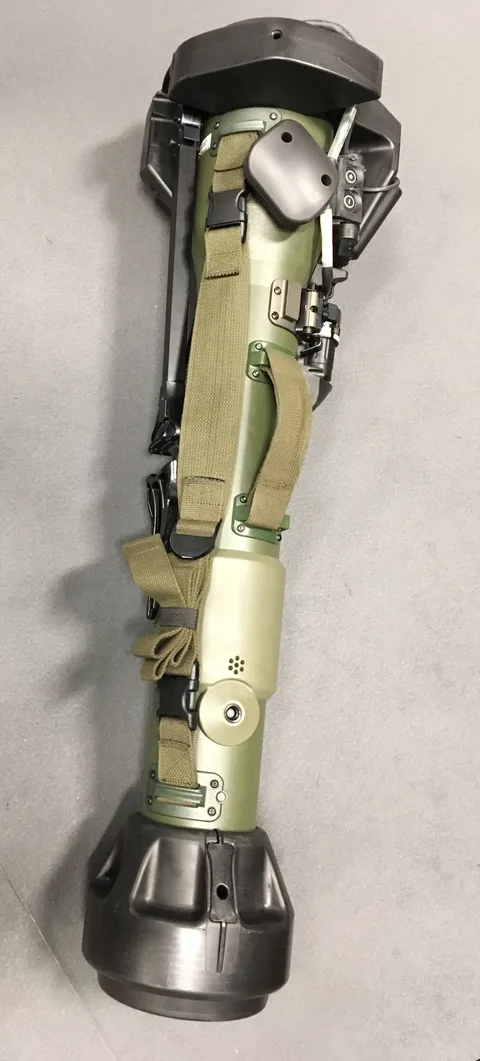 NLAWShort-range anti-tank weaponSide: UkraineBuilt: Saab Bofors Dynamics / Thales Air Defence / Sweden / United KingdomA shoulder-fired anti-tank weapon supplied in large numbers before and after the 2022 full-scale invasion. Its simple employment made it valuable for infantry ambushes.