Profile
- Type
- Road-mobile medium-range ballistic missile
- Conflict side
- Iran
- Origin
- Iran
- Service note
- In service from the 2010s; documented in 2026 U.S.-Iran conflict reporting
Sejjil is an Iranian road-mobile, two-stage solid-propellant medium-range ballistic missile developed as a faster-launching alternative to Iran's older liquid-fueled Shahab-family systems. Open-source assessments credit it with roughly 2,000 km range, a heavy single warhead, and an operational role in Iran's long-range strike force, with 2026 reporting documenting IRGC use during Operation True Promise 4.

Iran's IRGC reported firing Sejjil missiles during Operation True Promise 4 after U.S.-Israeli strikes on Iran, with sources describing the launch as part of retaliatory missile waves against Israeli and American-linked positions.
 Fattah-2Road-mobile hypersonic glide vehicle missileFattah-2 is an Iranian long-range missile displayed by the IRGC Aerospace Force as a successor to the Fattah family, pairing a ballistic booster with a maneuvering glide or re-entry vehicle. Janes described the unveiled system as using a Fattah-like motor and a distinct second-stage vehicle, while later Iranian and secondary reporting tied the missile to Operation True Promise 4 strikes during the United States-Iran Conflict.
 GhadrMedium-range ballistic missileGhadr is an Iranian medium-range ballistic missile family derived from the Shahab-3 line, with a lighter airframe, conic reentry vehicle, and range class intended to hold regional targets at risk. It is associated with Shahid Hemmat Industrial Group and Iran's Aerospace Industries Organization, and recent reporting directly documents Ghadr use by Iran during the June 2025 missile exchange connected to the United States-Iran Conflict archive.
.jpg?width=480) Haj QassemRoad-mobile solid-fuel medium-range ballistic missileHaj Qassem, also rendered Haj Qasem or Shahid Haj Qasem, is an Iranian road-mobile solid-fuel medium-range ballistic missile in the Fateh-family design line. Public reference data gives it a roughly 1,400 km range and a 500 kg-class warhead, placing it among Iran's longer-range solid-propellant precision-strike systems for attacks on regional bases and cities.
Haj QassemRoad-mobile solid-fuel medium-range ballistic missileHaj Qassem, also rendered Haj Qasem or Shahid Haj Qasem, is an Iranian road-mobile solid-fuel medium-range ballistic missile in the Fateh-family design line. Public reference data gives it a roughly 1,400 km range and a 500 kg-class warhead, placing it among Iran's longer-range solid-propellant precision-strike systems for attacks on regional bases and cities..jpg?width=480) Khorramshahr-4Road-mobile medium-range ballistic missileKhorramshahr-4, also known as Kheibar, is Iran's fourth-generation Khorramshahr-family liquid-fueled medium-range ballistic missile. It pairs a roughly 2,000-3,000 km range class with a heavy warhead and a maneuvering reentry vehicle, giving Iran a road-mobile deep-strike system that featured in 2025 reporting on the United States-Iran Conflict.
Khorramshahr-4Road-mobile medium-range ballistic missileKhorramshahr-4, also known as Kheibar, is Iran's fourth-generation Khorramshahr-family liquid-fueled medium-range ballistic missile. It pairs a roughly 2,000-3,000 km range class with a heavy warhead and a maneuvering reentry vehicle, giving Iran a road-mobile deep-strike system that featured in 2025 reporting on the United States-Iran Conflict.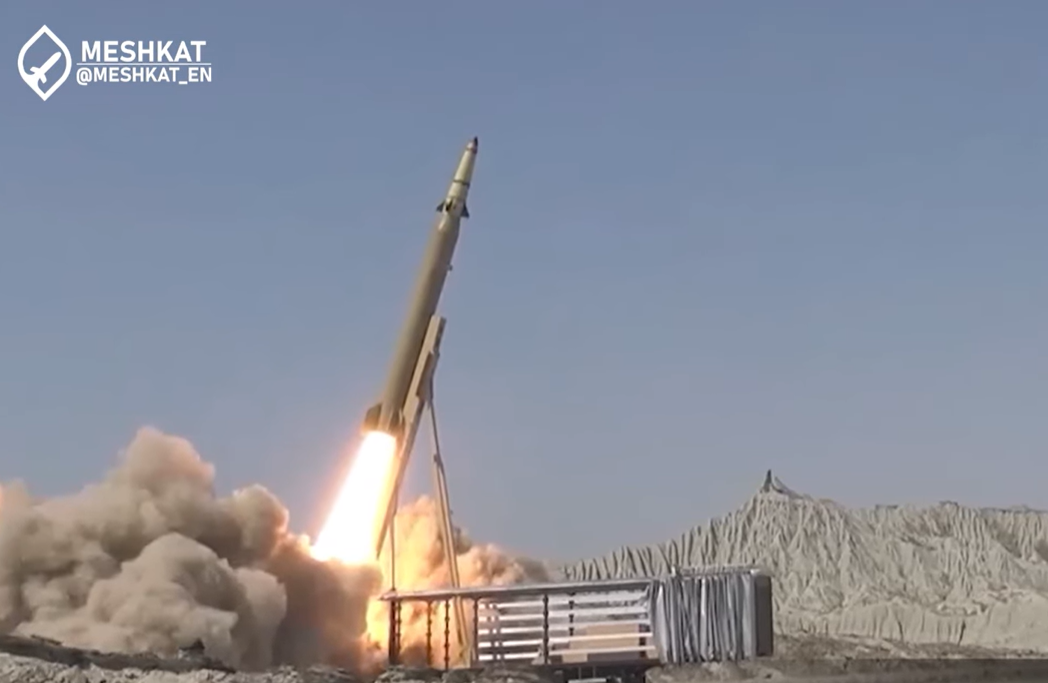 Qassem BasirMedium-range ballistic missileQassem Basir is an Iranian solid-fuel medium-range ballistic missile presented in 2025 as an upgraded Haj Qassem derivative with electro-optical terminal guidance for GPS-independent targeting. Open-source references describe it as a 1,200 km-class system with an approximately 500 kg payload and a claimed role against layered U.S. and Israeli missile defenses, though current conflict reporting treats it as an advanced system not yet confirmed in combat use.
.jpg?width=480) Qiam-1Road-mobile short-range ballistic missileThe Qiam-1 is an Iranian road-mobile, liquid-fueled short-range ballistic missile derived from the Shahab-2/Scud family but redesigned with a separable warhead and finless baseline airframe. It gives Iran and aligned Houthi forces a theater strike weapon in the 700-800 km range class, with documented use in Syria, Yemen-linked attacks on Saudi targets, and Iran's January 2020 strikes on U.S. forces in Iraq.
Qiam-1Road-mobile short-range ballistic missileThe Qiam-1 is an Iranian road-mobile, liquid-fueled short-range ballistic missile derived from the Shahab-2/Scud family but redesigned with a separable warhead and finless baseline airframe. It gives Iran and aligned Houthi forces a theater strike weapon in the 700-800 km range class, with documented use in Syria, Yemen-linked attacks on Saudi targets, and Iran's January 2020 strikes on U.S. forces in Iraq.