Profile
- Type
- Supersonic all-weather tactical bomber and strike aircraft
- Conflict side
- Ukraine
- Origin
- Soviet Union
- Service note
- Cold War design, still used in the Russia-Ukraine War
The Su-24, NATO reporting name Fencer, is a Soviet-designed twin-engine tactical bomber built for low-level all-weather strike missions. In Ukrainian service during the Russia-Ukraine War, surviving Su-24M and Su-24MR aircraft became especially important after integration of Storm Shadow and SCALP-EG cruise missiles, allowing long-range attacks without relying on newer Western combat aircraft.

Ukrainian Su-24M/MR aircraft have been adapted as launch platforms for UK Storm Shadow and French SCALP-EG cruise missiles, giving Ukraine a standoff strike option against Russian targets in occupied territory.

 B-2 SpiritLow-observable strategic heavy bomberThe B-2 Spirit is a U.S. Air Force low-observable strategic heavy bomber built by Northrop Grumman for long-range conventional and nuclear strike. Its flying-wing design, intercontinental range, and ability to carry heavy precision weapons make it a specialized option for defended or deeply buried targets, with directly documented recent combat use against ISIS camps in Libya, Houthi weapons sites in Yemen, and Iranian military and nuclear targets.
 A1-CM FuriaFixed-wing tactical reconnaissance UAVThe A1-CM Furia is a Ukrainian electric fixed-wing tactical UAV built by Athlon Avia for reconnaissance and artillery fire correction. Developed after Ukraine's 2014 need for organic battlefield ISR, it gives Ukrainian units a portable sensor platform for locating targets, transmitting video, and adjusting indirect fire under wartime electronic-warfare pressure.
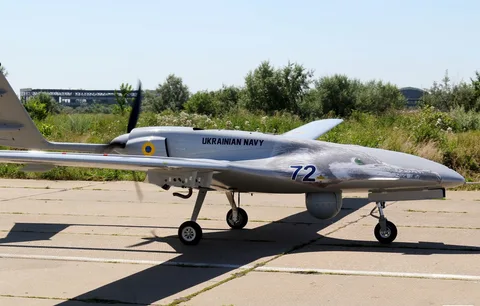 Bayraktar TB2Medium-altitude long-endurance UAVA Turkish unmanned aircraft used for reconnaissance and strike missions. It became especially prominent in the early phase of the full-scale invasion.
 ForpostReconnaissance and strike unmanned aerial vehicleForpost is Russia's license-built and later indigenized derivative of the Israeli IAI Searcher II UAV, used for reconnaissance, target acquisition, artillery-fire adjustment, and in Forpost-R form armed strike missions. In the Russia-Ukraine War, Russian forces have used Forpost-R aircraft as higher-value reusable UAVs for surveillance and precision attack roles rather than expendable one-way drones.
 MAGURA V5Unmanned surface vesselThe MAGURA V5 is a Ukrainian unmanned surface vessel built for reconnaissance, patrol, mine-warfare, fleet-security, and strike missions. In the Russia-Ukraine War it became one of Ukraine's best documented naval drones, used by Defence Intelligence units for long-range Black Sea attacks against Russian naval vessels.
.jpg?width=480) MiG-31Long-range interceptor and Kinzhal missile carrier variantThe MiG-31 is a Soviet-designed, twin-engine, two-seat long-range interceptor built for high-speed patrols, bomber interception, and wide-area air defense. In the Russia-Ukraine War, Russia's MiG-31K conversion has become important as the launch aircraft for Kh-47M2 Kinzhal air-launched ballistic missiles used in strikes against Ukraine.
MiG-31Long-range interceptor and Kinzhal missile carrier variantThe MiG-31 is a Soviet-designed, twin-engine, two-seat long-range interceptor built for high-speed patrols, bomber interception, and wide-area air defense. In the Russia-Ukraine War, Russia's MiG-31K conversion has become important as the launch aircraft for Kh-47M2 Kinzhal air-launched ballistic missiles used in strikes against Ukraine.