 Mohajer-6Armed intelligence, surveillance, target acquisition, and reconnaissance UAVSide: RussiaBuilt: Qods Aviation Industries / IranThe Mohajer-6 is an Iranian armed ISTAR UAV built by Qods Aviation Industries for surveillance, targeting, and light precision-strike missions. In the Russia-Ukraine War it is documented in Russian service, including examples downed or recovered by Ukraine, making it part of the broader Iranian UAV supply chain supporting Russian reconnaissance and attack operations.
Conflict archive
Russia-Ukraine War Weapons and Equipment
Russia-Ukraine War entries currently seeded from the original Ukraine equipment guide.
The current archive spans six equipment categories in this conflict, including tanks, armored vehicles, artillery, air defense, aircraft, UAVs, and infantry weapons.
Entries emphasize identifiable systems with dedicated pages, images, specifications, service context, and source links rather than broad equipment families.
238 weapon systemsCategory
Aircraft & UAVs
Crewed aircraft, drones, and loitering munitions.
Mohajer-6Armed intelligence, surveillance, target acquisition, and reconnaissance UAVSide: RussiaBuilt: Qods Aviation Industries / IranThe Mohajer-6 is an Iranian armed ISTAR UAV built by Qods Aviation Industries for surveillance, targeting, and light precision-strike missions. In the Russia-Ukraine War it is documented in Russian service, including examples downed or recovered by Ukraine, making it part of the broader Iranian UAV supply chain supporting Russian reconnaissance and attack operations..jpg?width=480) Ka-52Attack and reconnaissance helicopterSide: RussiaBuilt: Kamov, Progress Arsenyev Aviation Company, Russian Helicopters / RussiaThe Ka-52 is a Russian two-seat attack and reconnaissance helicopter derived from the Ka-50 and built around a coaxial rotor layout, side-by-side crew cockpit, 30 mm cannon, and guided-missile hardpoints. In the Russia-Ukraine War it became one of Russia's most visible rotary-wing strike platforms, especially in southern Ukraine where Ka-52 and Ka-52M crews used longer-range anti-tank missiles against Ukrainian ground forces.
Ka-52Attack and reconnaissance helicopterSide: RussiaBuilt: Kamov, Progress Arsenyev Aviation Company, Russian Helicopters / RussiaThe Ka-52 is a Russian two-seat attack and reconnaissance helicopter derived from the Ka-50 and built around a coaxial rotor layout, side-by-side crew cockpit, 30 mm cannon, and guided-missile hardpoints. In the Russia-Ukraine War it became one of Russia's most visible rotary-wing strike platforms, especially in southern Ukraine where Ka-52 and Ka-52M crews used longer-range anti-tank missiles against Ukrainian ground forces. Mi-28Attack helicopterSide: RussiaBuilt: Mil Moscow Helicopter Plant / Rostvertol / RussiaThe Mi-28 Havoc is a Russian two-seat attack helicopter developed for anti-armor, close air support, and armed reconnaissance missions. Modern Mi-28N/NM-family aircraft combine armored tandem cockpits, a 30 mm chin cannon, guided missiles, rockets, and day/night sensors; Russian forces have used the type in the Russia-Ukraine War, where helicopters have faced dense ground-based air-defense and drone threats.
 Mi-24/Mi-35Attack helicopter and armed assault transportSide: UkraineBuilt: Mil Moscow Helicopter Plant / Rostvertol / Soviet Union / RussiaThe Mi-24/Mi-35 Hind family combines an armored attack helicopter with limited troop-carrying capacity, giving operators a platform for close air support, anti-armor fires, and armed escort. In the Russia-Ukraine War, Ukraine has used legacy and donated Mi-24V/Mi-35 airframes for low-level rocket attacks and adapted some Hinds to carry Western unguided rockets.
.jpg?width=480) DJI Matrice 300 RTKCommercial quadcopter UAVSide: UkraineBuilt: DJI / ChinaThe DJI Matrice 300 RTK is a Chinese commercial enterprise quadcopter built around long-endurance inspection, mapping, and public-safety payloads. In the Russia-Ukraine War it appears as an off-the-shelf UAV in Ukrainian service, where donor-funded sets have been supplied for reconnaissance, observation, and front-line support tasks rather than as a purpose-built military aircraft.
DJI Matrice 300 RTKCommercial quadcopter UAVSide: UkraineBuilt: DJI / ChinaThe DJI Matrice 300 RTK is a Chinese commercial enterprise quadcopter built around long-endurance inspection, mapping, and public-safety payloads. In the Russia-Ukraine War it appears as an off-the-shelf UAV in Ukrainian service, where donor-funded sets have been supplied for reconnaissance, observation, and front-line support tasks rather than as a purpose-built military aircraft. DJI Mavic seriesCommercial quadcopter UAVSide: Ukraine / RussiaBuilt: DJI / ChinaThe DJI Mavic series is a family of Chinese commercial folding quadcopters that became a mass battlefield UAV in the Russia-Ukraine War. Although designed for civilian imaging, models such as the Mavic 3 and Mavic 3 Enterprise have been used by both Ukrainian and Russian forces for short-range ISR, artillery correction, situational awareness, and improvised attack roles.
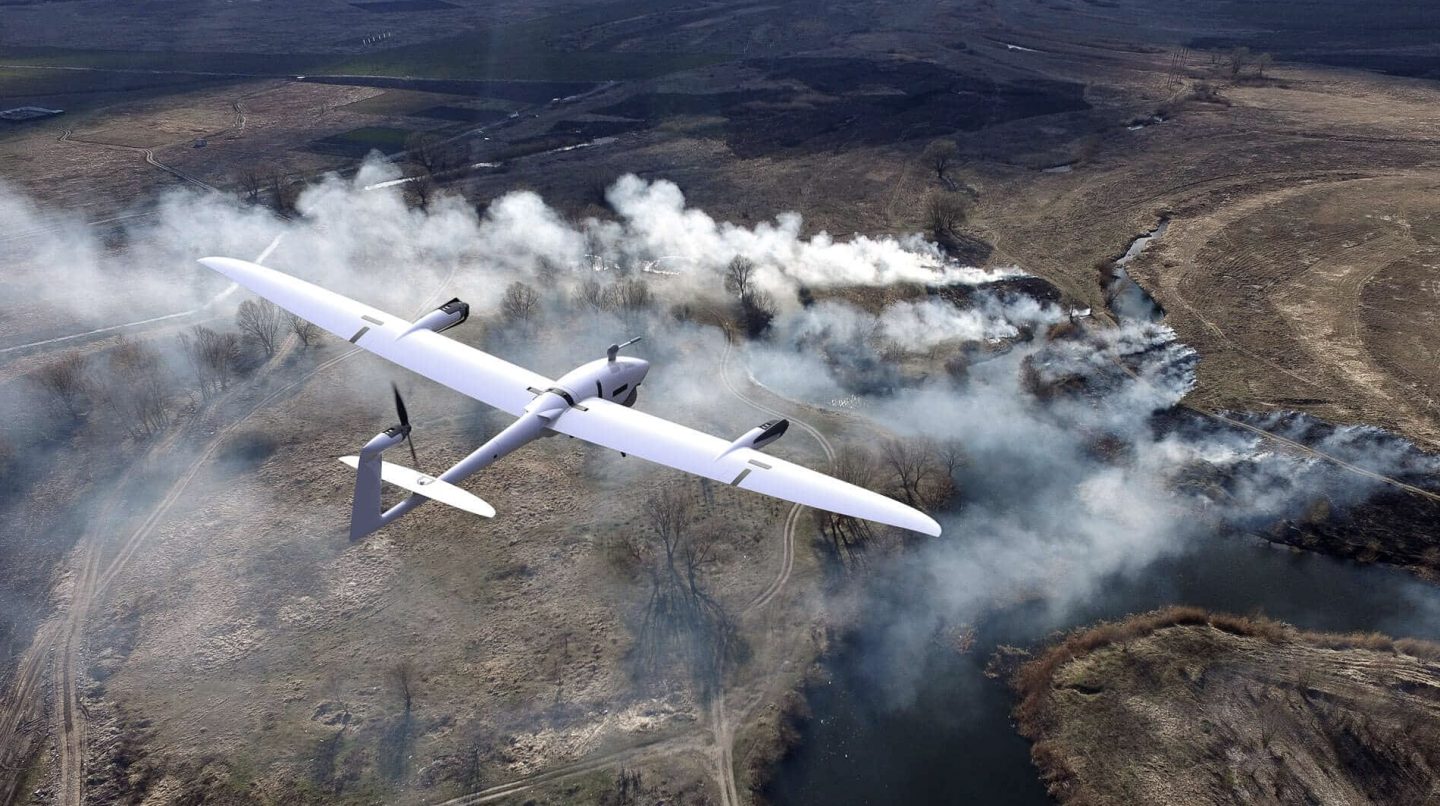 VectorElectric VTOL fixed-wing reconnaissance UAVSide: UkraineBuilt: Quantum Systems / GermanyVector is a German Quantum Systems electric VTOL fixed-wing small UAV built for mid-range intelligence, surveillance, and reconnaissance. In Ukrainian service it provides quiet launch-and-recovery flexibility, encrypted real-time video, EO/IR sensing, and AI-assisted target detection for front-line reconnaissance missions in contested conditions.
 Ukrainian Explosive Naval DronesExplosive unmanned surface vesselSide: UkraineBuilt: Ukrainian defense industry; SpetsTechnoExport; Security Service of Ukraine / UkraineUkrainian explosive naval drones are low-profile unmanned surface vessels developed during the Russia-Ukraine War to extend Ukrainian strike reach in the Black Sea. The family includes MAGURA V5 drones associated with Defence Intelligence of Ukraine operations and Sea Baby drones associated with the Security Service of Ukraine, pairing remote or semi-autonomous control with large explosive payloads for attacks on Russian naval targets.
 Su-57Fifth-generation multirole fighter aircraftSide: RussiaBuilt: United Aircraft Corporation / Sukhoi / RussiaThe Su-57, NATO reporting name Felon, is Russia's Sukhoi-designed fifth-generation multirole fighter, built for air-to-air combat and standoff strike missions with low-observable shaping, integrated avionics, and internal weapons carriage. In the Russia-Ukraine War it has appeared as a scarce Russian Aerospace Forces asset used cautiously, with documented Ukrainian reporting of a June 2024 strike against an Su-57 at Akhtubinsk airfield rather than routine overflight of defended Ukrainian airspace.
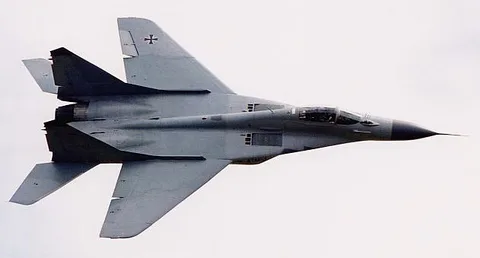 MiG-29Fighter aircraftSide: UkraineBuilt: Mikoyan / United Aircraft Corporation / Soviet Union / RussiaA twin-engine fighter already familiar to Ukrainian pilots before the invasion. Ukraine has adapted MiG-29s for air defense and for carrying some Western-supplied weapons.
 FPV dronesFirst-person-view small UAV / one-way attack droneSide: Ukraine / RussiaBuilt: Various commercial, volunteer, and defense-industry assemblers / VariousFPV drones are small first-person-view UAVs adapted from racing-drone and commercial quadcopter technology into tactical reconnaissance and attack systems. In the Russia-Ukraine War, both sides use them in large numbers because they can put a live camera feed and operator-guided explosive payload into places that are hard for artillery or larger UAVs to reach, while remaining cheap enough for attritional frontline use.
 Leleka-100Fixed-wing reconnaissance UAV systemSide: UkraineBuilt: DeViRo / UkraineThe Leleka-100 is a Ukrainian fixed-wing ISR unmanned aerial system from DeViRo, built around day/night reconnaissance, jamming-resistant communications, GPS-denied operation, and artillery fire correction. Ukrainian units use the system in the Russia-Ukraine War to find targets, relay corrections to fire units, and assess results while operating from positions behind the front line.
 SharkFixed-wing reconnaissance unmanned aerial systemSide: UkraineBuilt: Ukrspecsystems / UkraineShark is a Ukrainian fixed-wing reconnaissance UAS built by Ukrspecsystems for autonomous surveillance, target identification, and artillery fire adjustment. In Ukrainian service during the Russia-Ukraine War, Shark systems pair catapult-launched electric UAVs with mobile ground-control equipment and encrypted video links for operations behind the front line.
 A1-CM FuriaFixed-wing tactical reconnaissance UAVSide: UkraineBuilt: Athlon Avia / UkraineThe A1-CM Furia is a Ukrainian electric fixed-wing tactical UAV built by Athlon Avia for reconnaissance and artillery fire correction. Developed after Ukraine's 2014 need for organic battlefield ISR, it gives Ukrainian units a portable sensor platform for locating targets, transmitting video, and adjusting indirect fire under wartime electronic-warfare pressure.
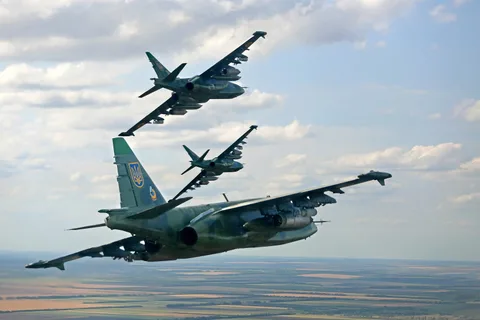 Su-25Ground-attack aircraftSide: UkraineBuilt: Sukhoi / United Aircraft Corporation / Soviet Union / Russia / GeorgiaA rugged attack aircraft used for close air support and battlefield strike missions. It operates in a highly dangerous air-defense environment on both sides of the war.
 Il-76Heavy military transport aircraftSide: UkraineBuilt: Ilyushin / Tashkent Aviation Production Association / Aviastar-SP / Soviet Union / Uzbekistan / RussiaThe Il-76 is a four-engine Soviet-designed heavy transport aircraft built for military airlift, cargo delivery, troop movement, and rough-field operations. In the Russia-Ukraine War archive it is documented through Ukrainian Air Force Il-76MD use during the 2014 Luhansk airport air bridge, where one aircraft was destroyed while carrying troops and equipment.
 SwitchbladeLoitering munitionSide: UkraineBuilt: AeroVironment / United StatesA family of portable loitering munitions supplied by the United States. These systems combine reconnaissance and one-way attack roles for small units.
 WarmateLoitering munitionSide: UkraineBuilt: WB Electronics / WB Group / PolandWarmate is a Polish electric loitering munition from WB Electronics/WB Group, designed as a portable reconnaissance-strike system with interchangeable warheads, autonomous flight modes, and video-guided terminal attack. In the Russia-Ukraine War it has been documented in Ukrainian service for precision attacks on Russian air-defense and surveillance radars.
 ZALA LancetLoitering munitionSide: RussiaBuilt: ZALA Aero Group / RussiaThe ZALA Lancet is a Russian electric loitering munition with a distinctive dual X-wing layout, launched from a catapult and guided by an onboard television channel for terminal attack. In the Russia-Ukraine War it became one of Russia's prominent tactical strike UAVs, used against Ukrainian artillery, air-defense systems, armor, vehicles, and other battlefield targets.
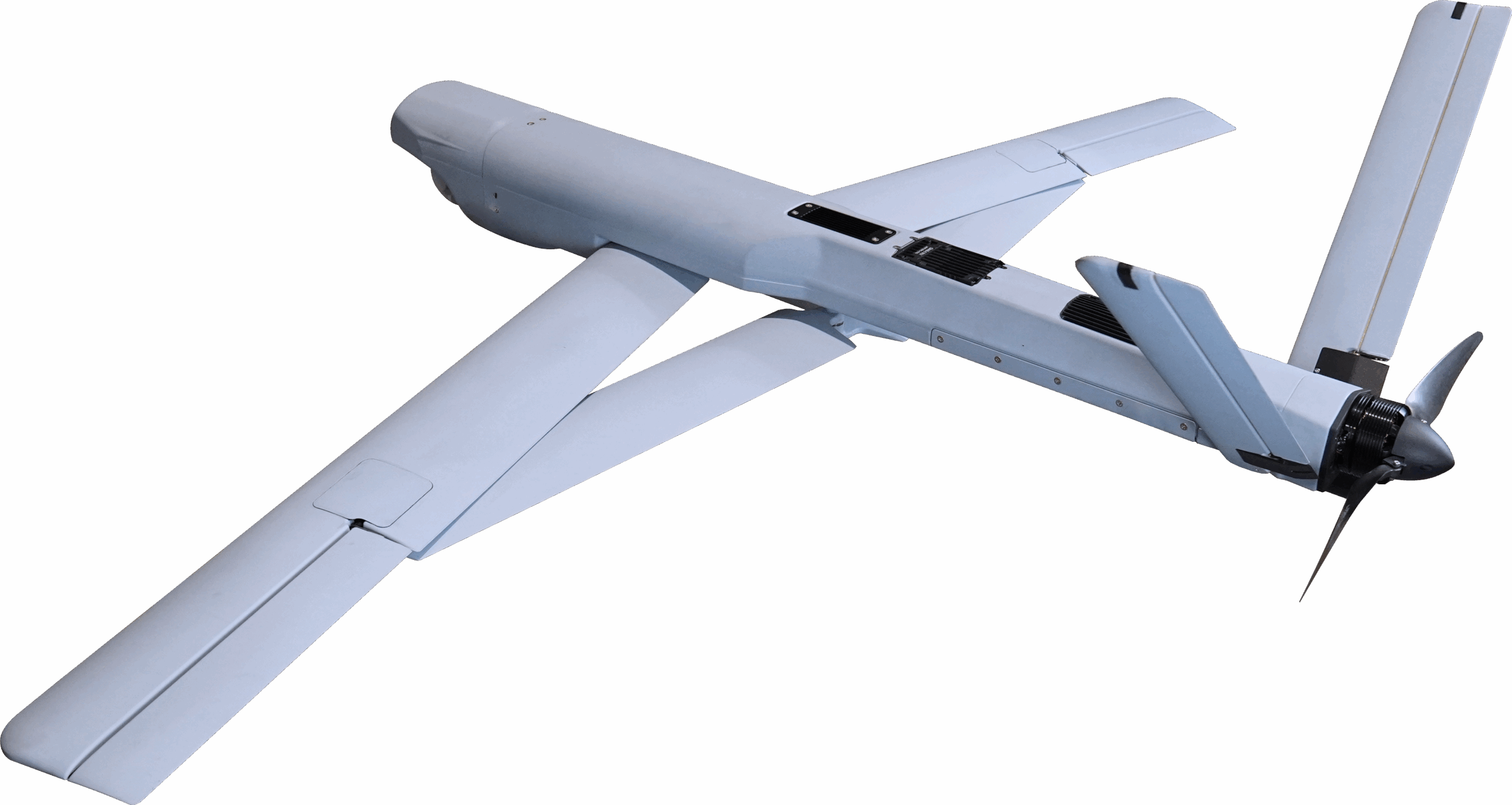 Phoenix GhostLoitering munition / one-way attack UASSide: UkraineBuilt: AEVEX Aerospace / United StatesPhoenix Ghost is an AEVEX Aerospace family of U.S. loitering munitions and one-way attack unmanned aircraft associated with urgent Ukraine security assistance. Public reporting and company material describe it as a family rather than a single fixed airframe, with disclosed AEVEX platforms ranging from smaller Group II precision-strike systems such as Atlas to larger Group III systems such as Disruptor and Dominator.
.jpg?width=480) MiG-31Long-range interceptor and Kinzhal missile carrier variantSide: RussiaBuilt: Mikoyan / Soviet Union / RussiaThe MiG-31 is a Soviet-designed, twin-engine, two-seat long-range interceptor built for high-speed patrols, bomber interception, and wide-area air defense. In the Russia-Ukraine War, Russia's MiG-31K conversion has become important as the launch aircraft for Kh-47M2 Kinzhal air-launched ballistic missiles used in strikes against Ukraine.
MiG-31Long-range interceptor and Kinzhal missile carrier variantSide: RussiaBuilt: Mikoyan / Soviet Union / RussiaThe MiG-31 is a Soviet-designed, twin-engine, two-seat long-range interceptor built for high-speed patrols, bomber interception, and wide-area air defense. In the Russia-Ukraine War, Russia's MiG-31K conversion has become important as the launch aircraft for Kh-47M2 Kinzhal air-launched ballistic missiles used in strikes against Ukraine. AN-196 LiutyiLong-range one-way attack UAVSide: UkraineBuilt: Ukroboronprom / Ukrainian Defense Industry / UkraineThe AN-196 Liutyi is a Ukrainian long-range one-way attack UAV developed after Russia began large-scale Shahed-type drone attacks. Open sources describe it as a runway-launched, twin-boom pusher aircraft built for deep strikes with a 75 kg-class warhead and a published range goal above 1,000 km, making it part of Ukraine's campaign against Russian refinery, logistics, industrial, and military targets far beyond the front line.
 BoberLong-range one-way attack UAV / loitering munitionSide: UkraineBuilt: UkrJet / UkraineThe Bober, also known as the UJ-26 Beaver, is a Ukrainian long-range one-way attack UAV associated with deep-strike missions against Russian military infrastructure. Open sources describe it as a pusher-propeller, canard-layout loitering munition with roughly 800 to 1,000 km of reported range and an approximately 20 kg warhead, giving Ukraine an indigenous strike option for targets far beyond the front line.
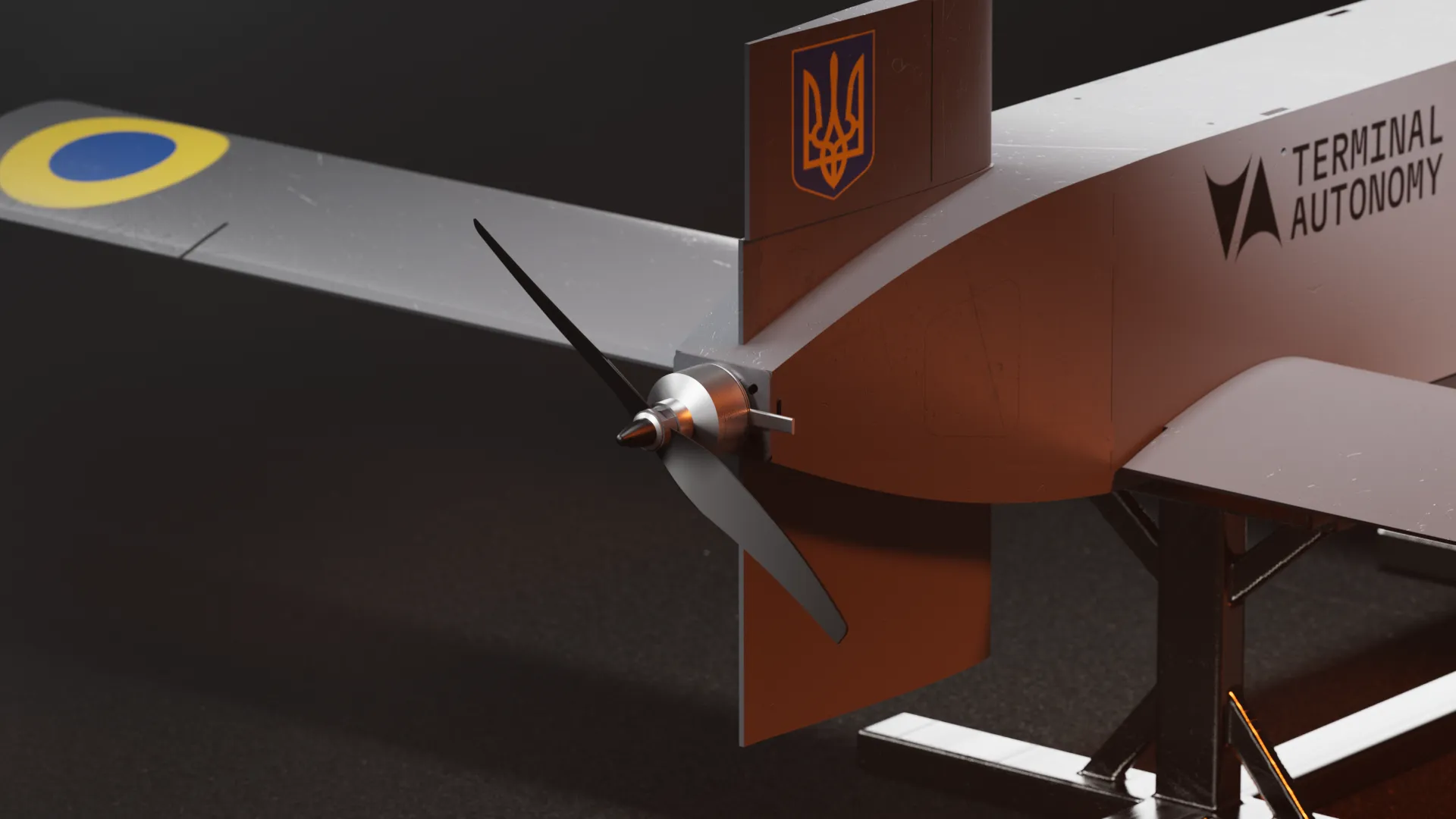 AQ-400 ScytheLong-range one-way strike UAVSide: UkraineBuilt: Terminal Autonomy / UkraineThe AQ-400 Scythe is a Ukrainian long-range one-way strike UAV developed by Terminal Autonomy for mass production and deep-strike missions. Its modular airframe, pusher-propeller layout, and visual/terrain-aided navigation are intended to provide Ukraine with a comparatively low-cost way to put a sizable payload hundreds of kilometers from the launch area under electronic-warfare pressure.
 Tu-22MLong-range supersonic bomber and missile carrierSide: RussiaBuilt: Tupolev / Kazan Aircraft Production Association / Soviet Union / RussiaThe Tu-22M, best known in current Russian service as the Tu-22M3 Backfire-C, is a variable-sweep long-range bomber and missile carrier designed by Tupolev for strategic strike and maritime attack missions. In the Russia-Ukraine War, Russian forces have used the type as a standoff launch platform for Kh-22-series missiles and for reported bombing attacks against Mariupol.
 Mi-8/Mi-17Medium twin-turbine utility transport helicopterSide: UkraineBuilt: Kazan Helicopters / Ulan-Ude Aviation Plant / RussiaThe Mi-8/Mi-17 is a Soviet-designed medium utility helicopter family used for troop lift, cargo transport, evacuation, search-and-rescue, and armed support roles. Its large production run, 4,000 kg payload class, and widespread operator base make it one of the defining rotary-wing platforms in the Russia-Ukraine War, where Ukraine operates legacy and donor-supplied Mi-17 aircraft.
 OrionMedium-altitude long-endurance reconnaissance-strike UAVSide: RussiaBuilt: Kronstadt Group / RussiaOrion, also known as Inokhodets, is a Russian medium-altitude long-endurance unmanned aircraft developed by Kronstadt for persistent reconnaissance and precision strike missions. In the Russia-Ukraine War it has appeared in limited Russian service, with documented strikes, combat losses, and Ukrainian intelligence reporting on its production chain and foreign components.
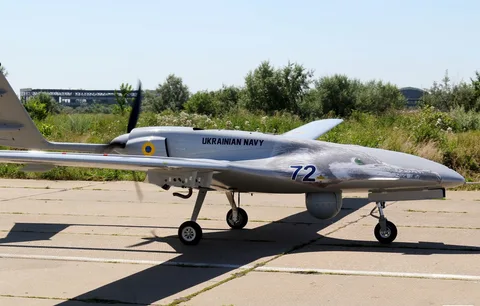 Bayraktar TB2Medium-altitude long-endurance UAVSide: UkraineBuilt: Baykar / TurkeyA Turkish unmanned aircraft used for reconnaissance and strike missions. It became especially prominent in the early phase of the full-scale invasion.
.jpg?width=480) Orlan-10Medium-range reconnaissance and electronic-warfare UAVSide: RussiaBuilt: Special Technology Centre / RussiaThe Orlan-10 is a Russian medium-range unmanned aircraft built by Special Technology Centre for reconnaissance, artillery spotting, electronic warfare, and data-relay missions. In the Russia-Ukraine War it became one of Russia's most important tactical UAVs, helping locate Ukrainian units and pass targeting data to artillery, missile, and loitering-munition crews.
Orlan-10Medium-range reconnaissance and electronic-warfare UAVSide: RussiaBuilt: Special Technology Centre / RussiaThe Orlan-10 is a Russian medium-range unmanned aircraft built by Special Technology Centre for reconnaissance, artillery spotting, electronic warfare, and data-relay missions. In the Russia-Ukraine War it became one of Russia's most important tactical UAVs, helping locate Ukrainian units and pass targeting data to artillery, missile, and loitering-munition crews. Sea KingMulti-role maritime helicopterSide: UkraineBuilt: Westland Helicopters / United KingdomThe Sea King is the British-built Westland WS-61 version of the Sikorsky S-61, adapted for naval anti-submarine, search-and-rescue, utility, and transport missions. In the Russia-Ukraine War, Ukraine's Sea Kings come from allied donations rather than new production, giving Ukrainian naval aviation a proven twin-engine maritime helicopter for rescue, reconnaissance, coast guard support, and transport tasks.
 F-16 Fighting FalconMultirole fighter aircraftSide: UkraineBuilt: General Dynamics / Lockheed Martin / United StatesThe F-16 Fighting Falcon is a U.S.-designed multirole fighter used for air defense, air-to-air combat, and precision strike missions. Ukraine's receipt of the aircraft marked its move toward Western combat aviation during the Russia-Ukraine War, with official Ukrainian reporting confirming that pilots had begun using F-16s by August 2024.
 Mirage 2000Multirole fighter aircraftSide: UkraineBuilt: Dassault Aviation / FranceThe Mirage 2000 is a French single-engine multirole fighter designed by Dassault Aviation around a delta-wing airframe and SNECMA M53-P2 engine. France transferred Mirage 2000-5 aircraft to Ukraine in 2025, adding a Western fighter type for air-defense missions against Russian missile, drone, and aircraft threats.
 Black HornetNano reconnaissance UAVSide: UkraineBuilt: Teledyne FLIR Defense / Norway / United StatesThe Black Hornet is a pocket-sized military nano-UAV used by dismounted troops for short-range reconnaissance, target identification, and immediate situational awareness. In Ukraine, donated Black Hornet 3 systems give small units a low-signature day and thermal sensor that can look over obstacles, into urban terrain, and around trench lines without exposing an operator.
 Sea Baby USVNaval unmanned surface vehicleSide: UkraineBuilt: Security Service of Ukraine / UkraineSea Baby is a Ukrainian naval unmanned surface vehicle developed and operated by the Security Service of Ukraine for long-range strike missions in the Black Sea. Official Ukrainian sources describe it as a small, fast USV able to carry a large explosive load over about 1,000 kilometers, giving Ukraine a domestically built means to attack Russian ships, port targets, and bridge infrastructure despite limited conventional naval forces.
 Shahed-136One-way attack droneSide: RussiaBuilt: Shahed Aviation Industries / HESA / IranThe Shahed-136 is an Iranian-designed one-way attack drone associated with mass long-range strikes, appearing as the Russian Geran family in Ukraine and as an Iranian attack-drone threat in the U.S.-Iran conflict.
 ForpostReconnaissance and strike unmanned aerial vehicleSide: RussiaBuilt: Ural Civil Aviation Plant (UZGA) / RussiaForpost is Russia's license-built and later indigenized derivative of the Israeli IAI Searcher II UAV, used for reconnaissance, target acquisition, artillery-fire adjustment, and in Forpost-R form armed strike missions. In the Russia-Ukraine War, Russian forces have used Forpost-R aircraft as higher-value reusable UAVs for surveillance and precision attack roles rather than expendable one-way drones.
 PunisherReusable strike and reconnaissance UAVSide: UkraineBuilt: UA Dynamics / UkraineThe Punisher is a Ukrainian reusable fixed-wing strike UAV from UA Dynamics, designed for small-unit reconnaissance and precision bomb drops behind enemy lines. In the Russia-Ukraine War it has been fielded by Ukrainian defense units as a compact catapult-launched system carrying modular explosive containers for attacks on command posts, electronic-warfare equipment, ammunition sites, and other rear-area targets.Grad-armed Sea Baby dronesRocket-armed unmanned surface vesselSide: UkraineBuilt: Security Service of Ukraine / UkraineGrad-armed Sea Baby drones are Ukrainian Security Service unmanned surface vessels adapted from the Sea Baby naval drone into a reusable coastal-strike platform. The variant replaces or supplements the explosive-boat role with a compact launcher for 122 mm Grad rockets, allowing Ukrainian operators to fire from the sea at shore targets such as Russian positions on the Kinburn Spit while retaining the Sea Baby platform's long range and high-speed unmanned surface-vehicle profile.
 Su-35Single-seat multirole fighterSide: RussiaBuilt: United Aircraft Corporation (Sukhoi) / RussiaThe Su-35 is a Russian single-seat, twin-engine multirole fighter developed as a deep modernization of the Su-27 family. UAC presents it as a 4++ generation aircraft with thrust-vectoring 117S engines, long-range sensors, and an 8,000 kg combat load; in the Russia-Ukraine War, Su-35S aircraft have been documented in Russian service for air-to-air missions near the front and anti-radiation missile employment against Ukrainian air defenses.
_in_flight.jpg?width=480) Tu-95Strategic turboprop bomber and cruise-missile carrierSide: RussiaBuilt: Tupolev / Soviet Union / RussiaThe Tu-95 Bear is a Soviet-designed, four-engine turboprop strategic bomber that remains in Russian long-range aviation as a cruise-missile carrier. In the Russia-Ukraine War, the Tu-95MS variant is documented as one of the launch platforms for Kh-101 land-attack cruise missiles fired from standoff range against targets in Ukraine.
Tu-95Strategic turboprop bomber and cruise-missile carrierSide: RussiaBuilt: Tupolev / Soviet Union / RussiaThe Tu-95 Bear is a Soviet-designed, four-engine turboprop strategic bomber that remains in Russian long-range aviation as a cruise-missile carrier. In the Russia-Ukraine War, the Tu-95MS variant is documented as one of the launch platforms for Kh-101 land-attack cruise missiles fired from standoff range against targets in Ukraine. Su-24Supersonic all-weather tactical bomber and strike aircraftSide: UkraineBuilt: Sukhoi / Soviet Union / RussiaThe Su-24, NATO reporting name Fencer, is a Soviet-designed twin-engine tactical bomber built for low-level all-weather strike missions. In Ukrainian service during the Russia-Ukraine War, surviving Su-24M and Su-24MR aircraft became especially important after integration of Storm Shadow and SCALP-EG cruise missiles, allowing long-range attacks without relying on newer Western combat aircraft.
 Su-27Twin-engine air-superiority fighterSide: UkraineBuilt: Sukhoi / Soviet Union / RussiaThe Su-27, NATO reporting name Flanker, is a Soviet-designed twin-engine air-superiority fighter built around long range, high speed, and heavy air-to-air armament. Ukraine inherited the type after the Soviet collapse and has kept upgraded aircraft in combat during the Russia-Ukraine War, where Su-27s have been documented flying strike missions and carrying Western-supplied AGM-88 HARM missiles despite their Soviet avionics baseline.
 Sukhoi Su-30Twin-engine multirole fighter aircraftSide: RussiaBuilt: United Aircraft Corporation / Sukhoi / Irkut Corporation / RussiaThe Sukhoi Su-30 is a two-seat, twin-engine multirole fighter developed from the Su-27 family and fielded in several Russian and export variants. In the Russia-Ukraine War, Russian Su-30SM aircraft have been used around the Black Sea for combat aviation missions, where Ukrainian forces have documented high-profile losses including a 2025 naval-drone missile engagement near Novorossiysk.
 Su-34Twin-seat fighter-bomber / strike aircraftSide: RussiaBuilt: Sukhoi; Novosibirsk Aircraft Production Association / RussiaThe Su-34 Fullback is a Russian twin-seat fighter-bomber derived from the Su-27 family and built for long-range strike, interdiction, and reconnaissance missions. In the Russia-Ukraine War, Russian forces have relied on Su-34s as key launch aircraft for stand-off glide bombs, allowing heavy ordnance delivery while trying to remain outside many Ukrainian short-range air-defense envelopes.MAGURA V5Unmanned surface vesselSide: UkraineBuilt: SpetsTechnoExport / UkraineThe MAGURA V5 is a Ukrainian unmanned surface vessel built for reconnaissance, patrol, mine-warfare, fleet-security, and strike missions. In the Russia-Ukraine War it became one of Ukraine's best documented naval drones, used by Defence Intelligence units for long-range Black Sea attacks against Russian naval vessels.
Category
Air Defense
Systems that contest aircraft, missiles, helicopters, and drones.
 S-400 TriumfLong-range mobile surface-to-air missile systemSide: RussiaBuilt: Almaz-Antey / RussiaThe S-400 Triumf, NATO reporting name SA-21 Growler, is a Russian road-mobile long-range air defense system built around networked command, search radar, engagement radar, and transporter-erector-launchers. It is designed to engage aircraft, UAVs, cruise missiles, and some ballistic missile threats, and Russian S-400 batteries in occupied Crimea have been a recurring target in Ukraine's campaign against Russian air defenses.
 MIM-104 PatriotLong-range surface-to-air missile systemSide: UkraineBuilt: Raytheon (RTX) / Lockheed Martin / United StatesA high-end air defense system used by Ukraine against Russian air and missile attacks and by U.S. forces defending Al Udeid Air Base from Iranian ballistic missiles.
 S-300Long-range surface-to-air missile systemSide: UkraineBuilt: Almaz Central Design Bureau / Fakel Machine-Building Design Bureau / Soviet Union / RussiaThe S-300 is a Soviet-designed long-range surface-to-air missile family used by Ukraine for area air defense during the Russia-Ukraine War. Its mobile launchers, radars, and command elements give Ukrainian forces a legacy but still important way to contest aircraft, drones, cruise missiles, and some ballistic-missile threats while newer Western systems enter service.
 FIM-92 StingerMan-portable air-defense systemSide: UkraineBuilt: Raytheon (RTX) / United StatesA shoulder-fired missile used by infantry to threaten low-flying aircraft and helicopters. Stingers are part of the portable air defense layer that complicates Russian air operations.
 PPZR GromMan-portable air-defense systemSide: Russia-backed separatistsBuilt: MESKO S.A. / PolandPPZR Grom is a Polish shoulder-fired infrared surface-to-air missile system built by MESKO for short-range defense against visually acquired aircraft, helicopters, and other infrared-emitting targets. In the Russia-Ukraine War context, open-source arms researchers documented a Grom launcher tube reportedly seized from pro-Russian separatists in eastern Ukraine in 2014, making the entry a recovered-conflict-system record rather than a confirmed Ukrainian-operated aid item.
 9K333 VerbaMan-portable air-defense system (MANPADS)Side: RussiaBuilt: KB Mashinostroyeniya (KBM) / RussiaThe 9K333 Verba is a Russian shoulder-fired short-range surface-to-air missile system built around the 9M336 missile and a passive three-spectral thermal seeker. It is intended to engage low-flying aircraft, helicopters, unmanned aircraft, and cruise missiles, giving Russian small units a portable air-defense option in the Russia-Ukraine War.
 IglaMan-portable infrared-homing surface-to-air missile systemSide: UkraineBuilt: KB Mashinostroyeniya / Soviet Union / RussiaThe Igla family is a Soviet/Russian shoulder-fired MANPADS built to give small air-defense teams a mobile, infrared-guided weapon against low-flying aircraft, helicopters, drones, and cruise missiles. In the Russia-Ukraine War, Ukrainian units have used legacy Igla launchers alongside newer Western MANPADS as part of dispersed short-range air defense and mobile fire-group coverage.
 AspideMedium-range surface-to-air missileSide: UkraineBuilt: Selenia / MBDA Italy / ItalyAspide is an Italian semi-active radar guided missile family used in air-to-air and surface-to-air roles, including SPADA and Skyguard ground-based air defense systems. In the Russia-Ukraine War, Spain transferred an Aspide anti-aircraft missile battery and trained Ukrainian personnel to add another Western medium-range layer to Ukraine's air defense network.
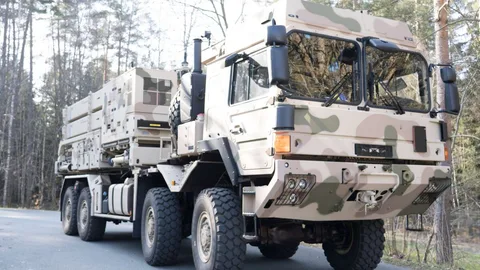 IRIS-T SLMMedium-range surface-to-air missile systemSide: UkraineBuilt: Diehl Defence / GermanyA German air defense system supplied to protect Ukrainian population centers and infrastructure. It is designed for high accuracy against aircraft, drones, and cruise missiles.
 MIM-23 HAWKMedium-range surface-to-air missile systemSide: UkraineBuilt: Raytheon Company / United StatesThe MIM-23 HAWK is a U.S.-origin medium-range surface-to-air missile system built around radar acquisition, target illumination, and semi-active radar-homing missiles. Developed for mobile low- to medium-altitude air defense and repeatedly upgraded after its 1960 fielding, HAWK returned to operational relevance in Ukraine through donated launchers, refurbished missiles, and sustainment support for air-defense fire units.
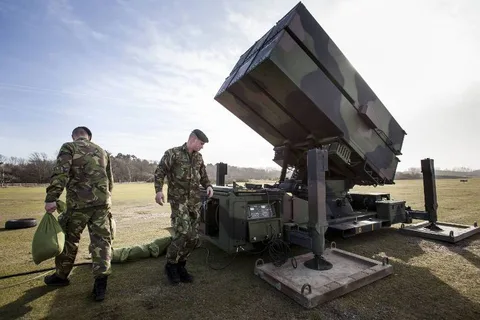 NASAMSMedium-range surface-to-air missile systemSide: UkraineBuilt: Kongsberg Defence & Aerospace / Raytheon (RTX) / Norway / United StatesA distributed air defense system using AMRAAM-family missiles. Its networked launchers and sensors make it valuable for defending urban areas and infrastructure.
 S-350 VityazMedium-range surface-to-air missile systemSide: RussiaBuilt: Almaz-Antey Air and Space Defence Corporation / RussiaThe S-350 Vityaz is a Russian mobile medium-range surface-to-air missile system developed for layered air defense against aircraft, helicopters, cruise missiles, UAVs, and some ballistic targets. In the Russia-Ukraine War it has appeared in Russian air-defense deployments near Ukraine and in later reporting from eastern Ukraine, where Ukrainian sources and defense reporting documented S-350 equipment being struck or destroyed.
 SAMP/TMobile long-range surface-to-air missile systemSide: UkraineBuilt: Eurosam (MBDA / Thales) / France / ItalySAMP/T, also known as MAMBA in French service, is a Franco-Italian truck-mounted air and missile defense system built around Aster interceptors, a multifunction radar, and battery command-and-control modules. In Ukrainian service it fills a scarce long-range air-defense role against Russian aircraft, cruise missiles, drones, and some ballistic-missile threats.
 VAMPIREModular counter-UAS rocket systemSide: UkraineBuilt: L3Harris Technologies / United StatesVAMPIRE, short for Vehicle-Agnostic Modular Palletized ISR Rocket Equipment, is an L3Harris counter-UAS rocket system built as a self-contained kit for trucks and other flatbed platforms. In Ukraine it pairs an EO/IR targeting sensor with four-shot APKWS laser-guided rocket launchers, giving ground forces a mobile way to engage hostile drones and some ground threats at lower cost than larger air-defense interceptors.
 SkynexNetworked short-range air defense systemSide: UkraineBuilt: Rheinmetall Air Defence AG / Switzerland / GermanySkynex is Rheinmetall Air Defence's modular short-range air defense architecture built around the Oerlikon Skymaster battle management system, networked sensors such as X-TAR3D, and autonomous effectors including 35 mm Revolver Gun Mk3 fire units with AHEAD air-burst ammunition. In Ukrainian service during the Russia-Ukraine War, the system fills a point-defense role against drones, cruise missiles, and other low-altitude threats around critical infrastructure.
 Flakpanzer GepardSelf-propelled anti-aircraft gunSide: UkraineBuilt: Krauss-Maffei Wegmann / KNDS Deutschland / GermanyThe Flakpanzer Gepard is a tracked German self-propelled anti-aircraft gun built around twin 35 mm automatic cannons and onboard search and tracking radars. In Ukraine it fills a short-range air defense role, pairing Leopard 1 mobility with gun-based engagement of low-flying aircraft, helicopters, missiles, and drones.
 AN/TWQ-1 AvengerSelf-propelled short-range air defense systemSide: UkraineBuilt: Boeing / United StatesThe AN/TWQ-1 Avenger is a Boeing-developed short-range air defense system that mounts a stabilized turret with Stinger missile pods and an M3P .50 caliber machine gun on a HMMWV chassis. In Ukrainian service it adds a mobile, point-defense layer against drones, helicopters, low-flying aircraft, and cruise-missile threats during the Russia-Ukraine War.
 Pantsir-S1Self-propelled short-range surface-to-air missile and anti-aircraft gun systemSide: Russia / UkraineBuilt: KBP Instrument Design Bureau / RussiaThe Pantsir-S1 is a Russian mobile point-defense system that combines command-guided surface-to-air missiles, twin 30 mm automatic cannon, radar tracking, and electro-optical fire control on a wheeled combat vehicle. It is intended to defend military units, air-defense sites, and infrastructure from aircraft, helicopters, cruise missiles, precision weapons, and UAVs, and has been documented in Russian service during the Russia-Ukraine War with some systems captured and reused by Ukraine.
 9K33 OsaShort-range self-propelled surface-to-air missile systemSide: Russia / UkraineBuilt: Izhevsk Electromechanical Plant (IEMZ) / Soviet UnionThe 9K33 Osa, NATO reporting name SA-8 Gecko, is a Soviet short-range self-propelled surface-to-air missile system that combines search radar, tracking radar, command guidance, and ready-to-fire missiles on a single amphibious 6x6 TELAR. In the Russia-Ukraine War it appears on both sides of the air-defense fight, including Ukrainian systems reinforced by Polish-supplied Osa vehicles and visually documented Russian losses.
 CrotaleShort-range surface-to-air missile systemSide: UkraineBuilt: Thales Group / FranceCrotale is a French short-range surface-to-air missile family built around radar and electro-optical target tracking. The Crotale NG variant paired the VT-1 missile with an integrated launcher, search radar, tracking radar, and optical sensors, making it useful for point defense of forces and fixed sites against low-altitude air threats. France supplied Crotale NG systems to Ukraine during the Russia-Ukraine War to reinforce layered air defense against Russian missiles, aircraft, helicopters, and drones.
 Tor-M2Short-range surface-to-air missile systemSide: RussiaBuilt: Almaz-Antey Air and Space Defence Corporation / RussiaThe Tor-M2 is a Russian short-range, self-propelled surface-to-air missile system built to protect maneuver forces and fixed sites from aircraft, helicopters, drones, guided missiles, and other precision weapons. In the Russia-Ukraine War it appears in Russian service as a tracked tactical air-defense vehicle, with visually documented battlefield losses showing its use close enough to the front to be targeted by Ukrainian forces.
 S-60Towed 57 mm anti-aircraft gunSide: UkraineBuilt: Plant No. 4 named after Voroshilov, Krasnoyarsk / Soviet UnionThe S-60 is a Soviet 57 mm towed anti-aircraft gun adopted in 1950 for low- and medium-altitude air defense. In Ukraine it has reappeared as an improvised, mobile gun system, often mounted on trucks and used less as a classic radar-directed anti-aircraft battery than as a rapid fire-support weapon against drones, positions, infantry, and light armored vehicles.
 ZU-23-2Towed twin 23 mm anti-aircraft autocannonSide: UkraineBuilt: KBP Instrument Design Bureau and multiple state/license producers / Soviet Union, Russia, Bulgaria, Poland, Egypt, ChinaThe ZU-23-2 is a Soviet twin 23 mm towed anti-aircraft autocannon built around two 2A14 guns on a light carriage. Its manual sighting, rapid emplacement, and high volume of fire make it a close-range air-defense weapon against low-flying aircraft, helicopters, and drones, while many operators also use it for direct fire against light vehicles and infantry positions. In the Russia-Ukraine War, Ukrainian units have kept the system relevant in mobile and positional air-defense teams.
 Buk-M2Tracked medium-range surface-to-air missile systemSide: RussiaBuilt: Almaz-Antey / RussiaThe Buk-M2 is a Russian tracked medium-range surface-to-air missile system in the Buk family, using the 9M317 missile and networked radars to defend maneuver forces and key areas against aircraft, helicopters, cruise missiles, precision weapons, and some ballistic targets. In the Russia-Ukraine War it appears on the Russian side as part of layered battlefield air defense, where Ukrainian forces have targeted its launchers and associated radar vehicles.
 ZSU-23-4 ShilkaTracked self-propelled anti-aircraft gunSide: Russia / UkraineBuilt: Mytishchi Machine-Building Plant / Ulyanovsk Mechanical Plant / Soviet UnionThe ZSU-23-4 Shilka is a Soviet tracked self-propelled anti-aircraft gun built around a radar-directed turret with four 23 mm autocannons. Designed to accompany maneuver forces against low-flying aircraft and helicopters, it remains relevant in Ukraine as a short-range air-defense and direct-fire platform, with visually documented losses on both Russian and Ukrainian sides.
 2K22 TunguskaTracked self-propelled gun-missile air defense systemSide: RussiaBuilt: KBP Instrument Design Bureau / Ulyanovsk Mechanical Plant / Soviet Union / RussiaThe 2K22 Tunguska is a Soviet-designed tracked short-range air defense system that combines twin 30 mm autocannons, 9M311-family surface-to-air missiles, search and tracking radars, and a protected self-propelled chassis. Built to cover maneuver formations against low-flying aircraft, helicopters, cruise missiles, and later unmanned threats, it appears in the Russia-Ukraine War mainly as a Russian front-line air-defense asset with visually documented combat losses.
.jpg?width=480) 9K35 Strela-10Tracked short-range surface-to-air missile systemSide: Ukraine / RussiaBuilt: Saratov Aggregate Plant / Kovrov Mechanical Plant / Soviet Union / RussiaThe 9K35 Strela-10, NATO reporting name SA-13 Gopher, is a Soviet tracked short-range air defense system mounted on an MT-LB chassis. Built to protect maneuver forces from low-flying aircraft, helicopters, cruise missiles, and UAVs, it remains relevant in Ukraine because both sides use mobile air-defense vehicles against the dense reconnaissance-drone threat.
9K35 Strela-10Tracked short-range surface-to-air missile systemSide: Ukraine / RussiaBuilt: Saratov Aggregate Plant / Kovrov Mechanical Plant / Soviet Union / RussiaThe 9K35 Strela-10, NATO reporting name SA-13 Gopher, is a Soviet tracked short-range air defense system mounted on an MT-LB chassis. Built to protect maneuver forces from low-flying aircraft, helicopters, cruise missiles, and UAVs, it remains relevant in Ukraine because both sides use mobile air-defense vehicles against the dense reconnaissance-drone threat.Category
Armored Vehicles
Troop carriers, infantry fighting vehicles, and protected mobility.
 Oshkosh M-ATV4x4 mine-resistant ambush protected vehicleSide: UkraineBuilt: Oshkosh Defense / United StatesThe Oshkosh M-ATV is a U.S.-built 4x4 MRAP designed to combine mine and ambush protection with better off-road mobility than earlier heavy MRAPs. Its V-hull, armored crew capsule, blast seats, TAK-4 independent suspension, and long road range make it useful as protected tactical transport, convoy security, and battlefield mobility equipment. In the Russia-Ukraine War, open-source reporting has documented M-ATVs in Ukrainian service as part of the broader flow of Western MRAPs used to move troops under mine, artillery, and small-arms threat.
 Bushmaster PMV4x4 protected mobility vehicleSide: UkraineBuilt: Thales Australia / AustraliaThe Bushmaster PMV is an Australian 4x4 protected mobility vehicle built by Thales Australia to move infantry under mine, IED, small-arms, and artillery-fragment threats. In Ukraine it became a prominent Australian military-aid vehicle, valued for protected troop transport and ambulance variants after Canberra committed multiple batches to the Ukrainian Armed Forces.
 BTR-608x8 amphibious armored personnel carrierSide: UkraineBuilt: Gorky Automobile Plant / Soviet UnionThe BTR-60 is a Soviet eight-wheeled amphibious armored personnel carrier that introduced the long-running BTR 8x8 layout later followed by the BTR-70 and BTR-80. Although lightly protected and ergonomically dated, the BTR-60 family remains relevant in Ukraine because older hulls can still move troops or be rebuilt as command, communications, evacuation, or upgraded APC variants.
 BTR-808x8 amphibious armored personnel carrierSide: RussiaBuilt: Arzamas Machine-Building Plant / RussiaThe BTR-80 is a Soviet-designed, Russian-produced 8x8 amphibious armored personnel carrier built to move motor rifle troops while providing machine-gun fire support. Armed with a 14.5 mm KPVT heavy machine gun and a coaxial 7.62 mm machine gun, it remains a common Russian wheeled APC in the Russia-Ukraine War, where documented losses include destroyed, abandoned, and captured vehicles.
 BTR-82/BTR-82A8x8 amphibious armored personnel carrierSide: RussiaBuilt: Military Industrial Company / RussiaThe BTR-82/BTR-82A is a Russian 8x8 amphibious armored personnel carrier developed from the BTR-80 family. The BTR-82A adds a stabilized 30 mm 2A72 cannon, improved sights, a 300 hp KAMAZ diesel, spall liners, and other mobility and survivability upgrades, making it one of the more heavily armed wheeled APCs widely documented with Russian units in the Russia-Ukraine War.
 Stryker8x8 armored personnel carrier familySide: UkraineBuilt: General Dynamics Land Systems / Canada / United StatesThe Stryker is an eight-wheeled General Dynamics armored vehicle family built around protected infantry mobility, common variants, and rapid road movement. In the Russia-Ukraine War, U.S.-supplied Stryker APCs expanded Ukraine's Western armored-vehicle fleet for troop transport, assault support, and obstacle-breaching packages when paired with mine rollers.
 BTR-38x8 wheeled armored personnel carrierSide: UkraineBuilt: Kyiv Armored Plant / UkrespectExport / UkraineThe BTR-3 is a Ukrainian 8x8 armored personnel carrier family derived from the Soviet-style wheeled APC layout but built around Ukrainian production and combat modules. In Ukrainian service, BTR-3 variants provide protected infantry mobility and turret fire support with a 30 mm cannon, machine gun, automatic grenade launcher, and anti-tank missile options.
 BTR-48x8 wheeled armored personnel carrier / infantry fighting vehicleSide: UkraineBuilt: Kharkiv Morozov Machine Building Design Bureau / Malyshev Plant / UkraineThe BTR-4 Bucephalus is a Ukrainian 8x8 armored personnel carrier and infantry fighting vehicle built around a rear troop compartment, amphibious mobility, and remote weapon stations such as the BM-7 Parus. In Ukrainian service it provides protected movement and direct fire support with a 30 mm cannon, machine gun, grenade launcher, and anti-tank missile capability.
 KTO Rosomak8x8 wheeled armored personnel carrier / infantry fighting vehicle familySide: UkraineBuilt: Rosomak S.A. / PolandThe KTO Rosomak is Poland's licensed Patria AMV-based 8x8 armored vehicle family, built by Rosomak S.A. in Siemianowice Slaskie for infantry transport, IFV, command, reconnaissance, medical, and mortar-carrier roles. In the Russia-Ukraine War, Rosomak vehicles became part of Polish-supported Ukrainian force modernization after official 2023 supply and purchase announcements.
 BMD-1Airborne amphibious infantry fighting vehicleSide: UkraineBuilt: Volgograd Tractor Plant / Soviet UnionThe BMD-1 is a Soviet airborne infantry fighting vehicle built for paratroop units, combining a very light amphibious tracked chassis with the BMP-1-style 73 mm 2A28 Grom gun and anti-tank missile armament. Its low weight and hydropneumatic suspension made it air-droppable, but the same design priorities left limited armor protection. In the Russia-Ukraine War archive, it is documented through Ukrainian Air Assault Forces service around Kramatorsk and Sloviansk in 2014.
 BMD-4/BMD-4MAirborne amphibious infantry fighting vehicleSide: RussiaBuilt: Volgograd Tractor Plant; KBP Instrument Design Bureau; Kurganmashzavod / RussiaThe BMD-4/BMD-4M is a Russian airborne amphibious infantry fighting vehicle built for VDV units, combining a light, parachutable tracked chassis with the Bakhcha-U turret's 100 mm gun-launcher, 30 mm autocannon, and coaxial machine gun. In the Russia-Ukraine War it appears as a Russian airborne assault vehicle, with open-source loss documentation and later production batches showing how Russia has continued fielding and modifying the type for a drone- and artillery-heavy battlefield.
 BMD-2Airborne infantry fighting vehicleSide: RussiaBuilt: Volgograd Tractor Plant / Soviet UnionThe BMD-2 is a Soviet airborne infantry fighting vehicle built for paratrooper units, combining a very light amphibious tracked chassis with a 30 mm 2A42 cannon and anti-tank missile launcher. Its air-droppable design gives Russian VDV formations mobile fire support, but the same weight limits leave the vehicle lightly protected against modern anti-armor weapons and artillery fragments documented in Ukraine.
 MT-LBAmphibious tracked armored personnel carrier and artillery tractorSide: Russia / UkraineBuilt: Kharkov Tractor Plant / Soviet UnionThe MT-LB is a Soviet tracked, amphibious armored carrier developed as a light multipurpose tractor and troop/cargo vehicle. Its low silhouette, large production run, and adaptable chassis made it a common base for command, air-defense, ambulance, anti-tank, and improvised fire-support variants, including widespread use by both sides in the Russia-Ukraine War.
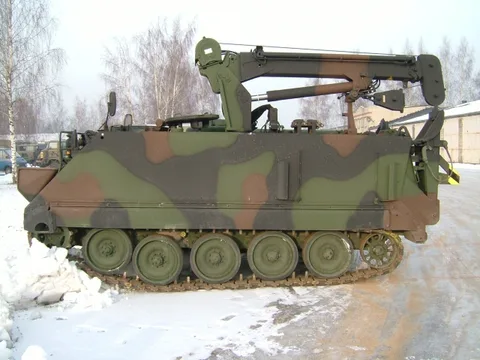 M113Armored personnel carrierSide: UkraineBuilt: FMC / BAE Systems / United StatesA simple, adaptable tracked armored carrier supplied in large numbers by partners. It is useful for protected mobility, casualty evacuation, and support roles behind the most intense fighting.
 Bandvagn 206Articulated tracked all-terrain carrierSide: UkraineBuilt: Hagglund & Soner; BAE Systems Hagglunds / SwedenThe Bandvagn 206 is a Swedish articulated tracked all-terrain carrier developed by Hagglunds for military mobility in snow, marsh, and other soft ground. Its two powered tracked units and amphibious layout make it useful as a troop, cargo, command, ambulance, or specialist support vehicle; Germany has documented deliveries of BV206 vehicles to Ukraine during the Russia-Ukraine War.
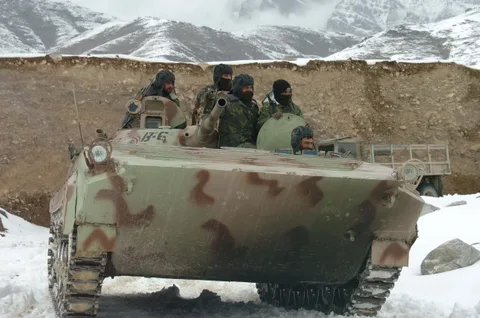 BMP-1Infantry fighting vehicleSide: UkraineBuilt: Kurganmashzavod and licensed producers / Soviet Union / licensed producersA tracked infantry fighting vehicle used to move troops under armor and provide direct fire support. It appears in Ukrainian service through legacy stocks, donor transfers, and battlefield captures.
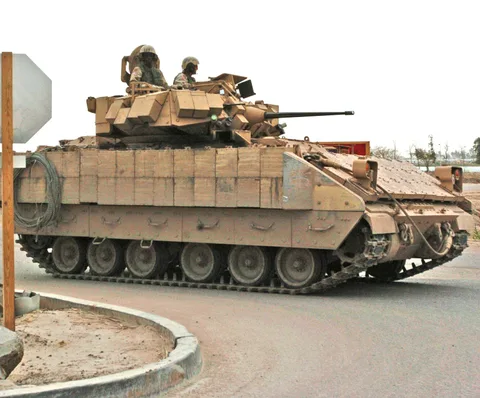 M2 BradleyInfantry fighting vehicleSide: UkraineBuilt: BAE Systems / United Defense / FMC / United StatesA U.S. infantry fighting vehicle valued for optics, survivability, and its 25 mm cannon. Ukrainian crews have used Bradleys for troop movement, fire support, and armored assaults.
 Marder 1A3Infantry fighting vehicleSide: UkraineBuilt: Rheinmetall Landsysteme / Maschinenbau Kiel / GermanyThe Marder 1A3 is a German tracked infantry fighting vehicle armed with a 20 mm cannon, machine gun, smoke launchers, and anti-tank missile capability. In the Russia-Ukraine War, Germany and Rheinmetall supplied refurbished Marder 1A3 vehicles to Ukraine to strengthen mechanized infantry mobility, protected troop movement, and direct fire support.
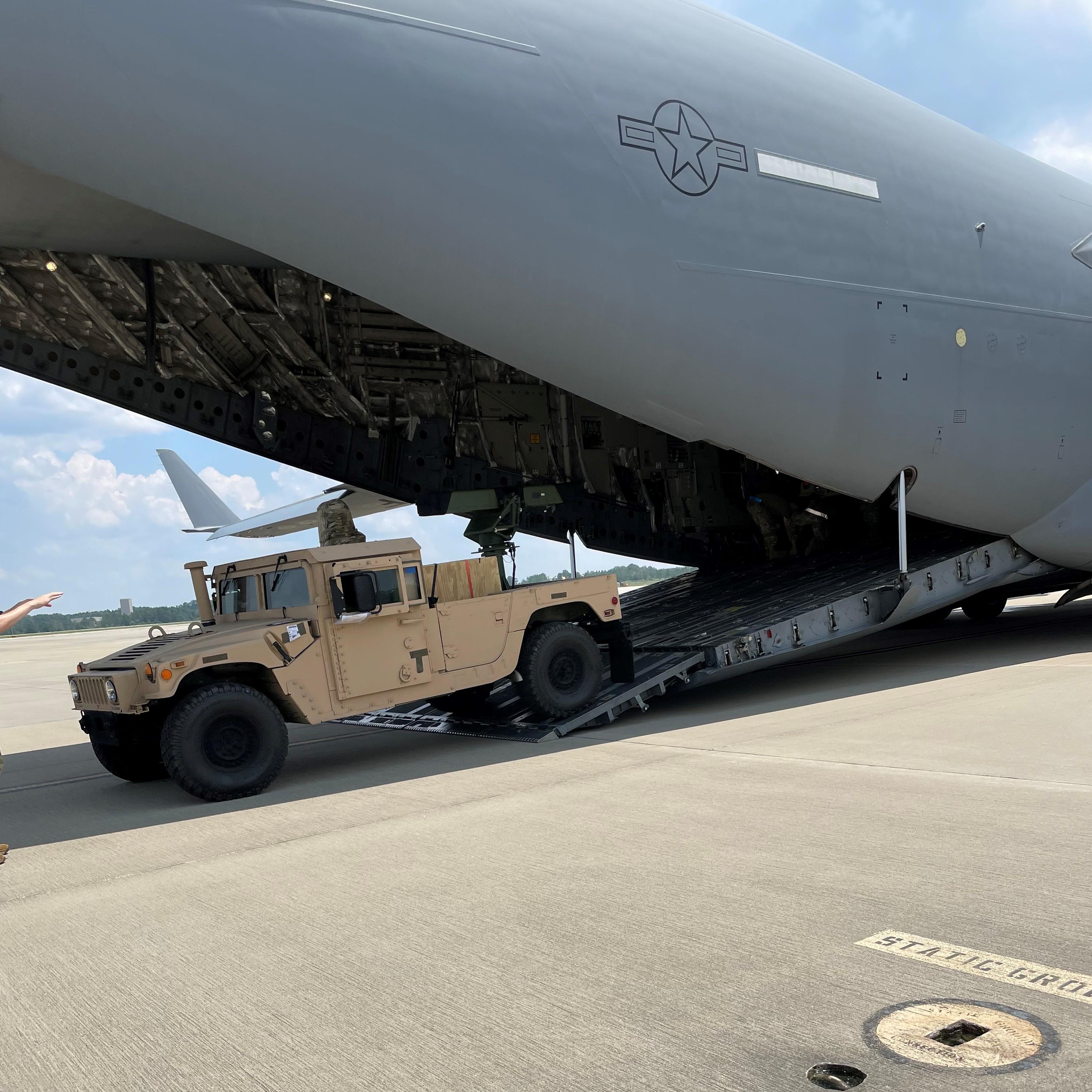
 HMMWVLight tactical wheeled vehicleSide: UkraineBuilt: AM General / United StatesThe High Mobility Multipurpose Wheeled Vehicle, better known as the HMMWV or Humvee, is an AM General 4x4 light tactical vehicle family used for troop movement, command, ambulance, cargo, and weapons-carrier roles. In the Russia-Ukraine War it appears as U.S.-supplied protected mobility at scale, with official U.S. security-assistance reporting listing more than 5,000 HMMWVs committed to Ukraine.
 BMC KirpiMine-resistant ambush protected armored personnel carrierSide: UkraineBuilt: BMC / TurkeyThe BMC Kirpi is a Turkish 4x4 mine-resistant ambush protected vehicle built around a V-shaped monocoque hull, protected troop seating, and wheeled battlefield mobility. In the Russia-Ukraine War it appears as donated Turkish protected mobility for Ukrainian units, including marine brigades, where its role is moving troops under artillery, mine, and small-arms threat rather than serving as a front-line fighting vehicle.
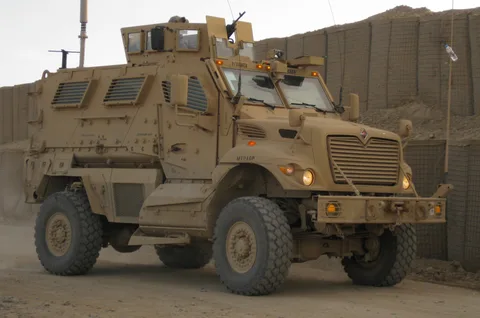 International MaxxProMine-resistant ambush protected vehicleSide: UkraineBuilt: Navistar Defense / United StatesA wheeled MRAP supplied to improve crew protection against mines, shell fragments, and ambushes. It is common in troop transport, patrol, and evacuation tasks.
.jpg?width=480) BTR-50Tracked amphibious armored personnel carrierSide: RussiaBuilt: Volgograd Tractor Plant / Soviet UnionThe BTR-50 is a Soviet tracked amphibious armored personnel carrier based on the PT-76 light tank chassis. Designed to move infantry and light weapons across rivers and broken terrain, it carries a small crew plus a large troop compartment and relies on thin welded steel armor rather than modern protection. Its appearance in Russian service during the Russia-Ukraine War highlights Moscow's use of older stored armored vehicles to replace battlefield losses.
BTR-50Tracked amphibious armored personnel carrierSide: RussiaBuilt: Volgograd Tractor Plant / Soviet UnionThe BTR-50 is a Soviet tracked amphibious armored personnel carrier based on the PT-76 light tank chassis. Designed to move infantry and light weapons across rivers and broken terrain, it carries a small crew plus a large troop compartment and relies on thin welded steel armor rather than modern protection. Its appearance in Russian service during the Russia-Ukraine War highlights Moscow's use of older stored armored vehicles to replace battlefield losses. AMX-10PTracked amphibious infantry fighting vehicleSide: UkraineBuilt: GIAT Industries (now Nexter) / FranceThe AMX-10P is a French tracked amphibious infantry fighting vehicle built by GIAT Industries to carry mechanized infantry with a 20 mm autocannon and light armor protection. Its Russia-Ukraine War entry is included with caution: late-2024 reporting tied the vehicle to Ukrainian operations around Kursk, while other defense reporting disputed both official transfer evidence and the Russian identification.
 BMP-2Tracked amphibious infantry fighting vehicleSide: Russia / UkraineBuilt: Kurganmashzavod / Soviet Union / RussiaThe BMP-2 is a Soviet tracked infantry fighting vehicle that replaced the BMP-1's low-velocity gun with a stabilized 30 mm 2A42 autocannon while retaining an anti-tank missile launcher and amphibious mobility. Its mix of troop carriage, direct fire, and ATGM capability keeps it widely present in post-Soviet armored units, including documented Russian and Ukrainian use during the Russia-Ukraine War.
 BMP-3Tracked amphibious infantry fighting vehicleSide: RussiaBuilt: Kurganmashzavod / RussiaThe BMP-3 is a Soviet-designed, Russian-built tracked amphibious infantry fighting vehicle notable for combining a 100 mm gun-launcher, 30 mm autocannon, and machine guns in a light armored troop carrier. In the Russia-Ukraine War it has appeared in Russian mechanized formations and fire-support roles, where its heavy armament is useful but its protection remains vulnerable to anti-armor weapons and drones.
 FV103 SpartanTracked armored personnel carrierSide: UkraineBuilt: Alvis Vehicles Ltd / United KingdomThe FV103 Spartan is the armored personnel carrier member of the British CVR(T) family, built by Alvis for moving small specialist teams under armor rather than a full infantry section. In Ukrainian service it provides a compact tracked mobility platform for troops and support teams, pairing light aluminum armor, a 7.62 mm machine gun, and high cross-country mobility useful in mud, snow, and broken terrain.
 FV430 BulldogTracked armored personnel carrierSide: UkraineBuilt: GKN Sankey / BAE Systems Land Systems / Rheinmetall BAE Systems Land / United KingdomThe FV430 Bulldog is the upgraded Mark 3 form of Britain's FV432 tracked armored personnel carrier, modernized with a diesel powerpack, automatic transmission, and improved protection for infantry transport and support roles. In the Russia-Ukraine War, the type is documented in UK military aid as part of a broader package of armored and protected vehicles for Ukrainian forces.
 BVP M-80Tracked infantry fighting vehicleSide: UkraineBuilt: FAMOS factory / YugoslaviaThe BVP M-80 is a Yugoslav tracked amphibious infantry fighting vehicle built to move infantry with armor protection while adding a 20 mm cannon, coaxial machine gun, and Malyutka anti-tank missile capability. In the Russia-Ukraine War record, the relevant variant is the Slovenian-held M80A, a more powerful production model that Slovenia transferred to Ukraine as armored mobility aid in 2022.
 CV90Tracked infantry fighting vehicleSide: UkraineBuilt: BAE Systems Hägglunds / SwedenThe CV90 is a Swedish tracked infantry fighting vehicle family built by BAE Systems Hägglunds for protected troop movement and direct-fire support. In Ukrainian service, Swedish-donated CV90s add a heavily armed Western IFV with strong cross-country mobility, a crewed turret, and support arrangements for training, maintenance, and additional vehicles.
 YPR-765Tracked infantry fighting vehicle and armored personnel carrier familySide: UkraineBuilt: FMC Corporation / DAF / RSV / RDM / United States / NetherlandsThe YPR-765 is the Dutch variant of the FMC AIFV family, a tracked infantry fighting vehicle and armored carrier derived from the M113 lineage. Dutch vehicles combine aluminum armor with spaced steel applique, road and amphibious mobility, and variant-specific weapons ranging from a 25 mm cannon to machine guns or remote weapon stations. In the Russia-Ukraine War, the Netherlands has supplied YPR vehicles to Ukrainian forces for protected mobility and fire-support roles.
 BTR-70Wheeled armored personnel carrierSide: RussiaBuilt: Gorky Automobile Plant / Arzamas Machine-Building Plant / Soviet UnionThe BTR-70 is a Soviet 8x8 amphibious armored personnel carrier developed from the BTR-60 family to move motor-rifle troops under small-arms and shell-fragment protection. Its one-man turret with a 14.5 mm KPVT heavy machine gun and 7.62 mm PKT coaxial machine gun made it a common Cold War APC, and Russian BTR-70 losses have been documented in the Russia-Ukraine War.
 Roshel SenatorWheeled armored personnel carrier and MRAP familySide: UkraineBuilt: Roshel / CanadaThe Roshel Senator is a Canadian 4x4 protected mobility vehicle family built by Roshel, with APC and MRAP variants used by Ukrainian forces for protected movement, border-security missions, and mine-threat environments during the Russia-Ukraine War. Its Ukraine experience helped drive the later MRAP version, which adds a V-shaped blast-resistant hull and STANAG-rated protection.
 AMX-10RCWheeled armored reconnaissance and fire-support vehicleSide: UkraineBuilt: Nexter / FranceThe AMX-10RC is a French wheeled armored reconnaissance and fire-support vehicle armed with a 105 mm gun. In the Russia-Ukraine War it represents a French transfer of mobile direct-fire armor to Ukrainian forces, intended for reconnaissance and supporting fire rather than main battle tank assault roles.
Category
Artillery
Tube artillery, rocket artillery, and long-range ground fires.
 M22460 mm lightweight company mortarSide: UkraineBuilt: Watervliet Arsenal / United StatesThe M224 is a U.S. 60 mm lightweight company mortar built for infantry close-support fires from either a conventional bipod/baseplate setup or a lighter handheld mode. Its modest weight, 70- to 3,490-meter conventional-mode range, and high-angle fire make it useful for small-unit suppression, screening, and illumination missions; Ukrainian forces have been documented employing U.S.-made M224 mortars during the Russia-Ukraine War.
 2B14 Podnos82 mm smoothbore mortarSide: Ukraine / Russia-backed forcesBuilt: Burevestnik / Gorky Engineering Plant / Soviet Union / RussiaThe 2B14 Podnos is a Soviet 82 mm smoothbore mortar developed in the early 1980s as a lighter, longer-ranged replacement for older battalion mortars. Its portable barrel, baseplate, and bipod loads make it suitable for light infantry fire support, and OSCE reporting documents Podnos mortars on both sides of the Donbas front during the Russia-Ukraine War.
 D-4485 mm towed field gunSide: UkraineBuilt: No. 9 Uralmashzavod / Soviet UnionThe D-44 is a Soviet 85 mm divisional field gun developed after World War II as a replacement for the 76 mm ZiS-3. Although originally a towed direct-fire and light artillery weapon, Ukrainian forces have documented improvised mobile use during the Russia-Ukraine War by mounting the gun on MT-LB carriers to gain limited shoot-and-scoot mobility.
 M119105 mm lightweight towed howitzerSide: UkraineBuilt: Rock Island Arsenal Joint Manufacturing and Technology Center / Royal Ordnance / United States / United KingdomThe M119 is the U.S. 105 mm lightweight towed howitzer derived from the British L119 light gun and built around air-mobile infantry fire support. The M119A3 variant adds digital fire control, self-location, and communications upgrades while retaining a light carriage that can be moved by trucks, cargo aircraft, or helicopter. In the Russia-Ukraine War, Ukrainian forces received 105 mm howitzers and were documented training on American M119A3 guns to add a mobile, NATO-standard light artillery option alongside heavier 155 mm systems.
 M101 105 mm Howitzer105 mm towed field howitzerSide: UkraineBuilt: Rock Island Arsenal / United StatesThe M101 is a U.S.-origin 105 mm towed field howitzer whose low weight, standard 105 mm ammunition, and simple split-trail carriage kept it useful long after World War II. In Ukraine, Lithuanian-donated M101A1 guns provide shorter-range tube artillery for infantry fire support where mobility, available ammunition, and survivable dispersed gun positions matter more than modern 155 mm range.
 L118 Light Gun105 mm towed light howitzerSide: UkraineBuilt: BAE Systems / United KingdomThe L118 Light Gun is a British 105 mm towed artillery system built for mobile field artillery, airborne movement, and rapid emplacement. In the Russia-Ukraine War, Ukraine's directly sourced combat context is tied to the L119 variant of the same light-gun family, supplied by the United Kingdom and supported by allied training and maintenance.
 OTO Melara Mod 56105 mm towed pack howitzerSide: UkraineBuilt: OTO Melara / ItalyThe OTO Melara Mod 56 is an Italian 105 mm pack howitzer built for light and mountain artillery, combining a low towing weight with a design that can be broken down into transportable loads. In the Russia-Ukraine War it appears as a Spanish-supplied light artillery system for Ukrainian forces, trading range and shell weight for mobility and compatibility with 105 mm artillery ammunition.
 2S12 Sani120 mm heavy mortar systemSide: RussiaBuilt: Motovilikha Plants / Uraltransmash / Rostec-affiliated Russian defense industry / Soviet Union / RussiaThe 2S12 Sani is a Soviet/Russian 120 mm mortar system built around the 2B11 mortar, a wheeled carriage, and a transport vehicle. It gives battalion-level units a mobile indirect-fire weapon with a roughly 7 km range, and modernized 2S12A systems on Ural-based vehicles have continued to appear in Russian supply and combat reporting during the Russia-Ukraine War.
 MO-120 RT120 mm rifled towed heavy mortarSide: UkraineBuilt: Brandt / TDA Armements / Thales / FranceThe MO-120 RT is a French 120 mm rifled towed heavy mortar developed by Brandt and later associated with TDA/Thales production. Its rifled barrel, two-wheel carriage, and rocket-assisted ammunition option give it longer range than many smoothbore infantry mortars, while remaining towable by light or medium vehicles. In the Russia-Ukraine War, Ukrainian forces received Belgian MO-120 RT mortars and used the type for front-line indirect fire support.
 120-PM-38120 mm towed heavy mortarSide: UkraineBuilt: Plant No. 92 Nizhny Novgorod / Soviet UnionThe 120-PM-38, also known as the M1938, is a Soviet 120 mm smoothbore heavy mortar designed under B. I. Shavyrin and built for infantry fire support. Its large mortar bomb, wheeled transport arrangement, and roughly 5.7 km range made it a durable Soviet artillery design, with Ukrainian stocks still documented around the Russia-Ukraine War rather than acquired as a modern foreign transfer.
 PM-43120 mm towed heavy mortarSide: Russian-backed separatist forcesBuilt: Soviet state arsenals / Soviet UnionThe PM-43 is a Soviet 120 mm smoothbore heavy mortar, a strengthened wartime development of the PM-38 that combined a large high-explosive bomb, a two-wheel carriage, and a six-person crew for infantry fire support. OSCE monitoring documented a probable PM-43 in a non-government-controlled area of Luhansk oblast during the Russia-Ukraine War, showing how legacy Soviet mortars remained present alongside newer 120 mm systems.
 2S23 Nona-SVK120 mm wheeled self-propelled gun-mortarSide: Russia / UkraineBuilt: Motovilikha Plants Corporation / Arzamas Machine-Building Plant / RussiaThe 2S23 Nona-SVK is a Russian 120 mm self-propelled gun-mortar that adapts the Nona artillery system to a BTR-80 8x8 armored chassis. Its rifled 2A60 weapon can provide direct or indirect fire with mortar bombs and artillery projectiles, giving motorized units a compact battalion-level fire-support vehicle. In the Russia-Ukraine War, Russian 2S23s have appeared in battlefield reporting and visually confirmed loss records, including destroyed and captured vehicles.
 2S40 Floks120 mm wheeled self-propelled howitzer/mortarSide: RussiaBuilt: Burevestnik Central Research Institute / Uralvagonzavod / Rostec / RussiaThe 2S40 Floks is a Russian 120 mm wheeled self-propelled artillery system on an armored Ural-4320 6x6 chassis, built to combine mortar, howitzer-style indirect fire, and direct-fire roles. Its documented Russia-Ukraine War appearance is notable because Ukrainian sources reported FPV-drone strikes against the new system soon after Rostec announced deliveries to Russian forces in October 2023.
 Tornado-G122 mm multiple launch rocket systemSide: RussiaBuilt: Splav Scientific Production Enterprise / RussiaThe Tornado-G is Russia's 9K51M 122 mm multiple launch rocket system, a modernized Grad-family launcher with automated laying and fire-control equipment intended to shorten setup, firing, and displacement times for rocket artillery units. In the Russia-Ukraine War it appears as a Russian-operated fire-support system, with documented battlefield losses and captures.
 BM-21 Grad122 mm multiple rocket launcherSide: Russia / UkraineBuilt: Motovilikha Plants / Soviet defense industry / Soviet Union / RussiaThe BM-21 Grad is a Soviet 122 mm multiple rocket launcher built around a 40-tube launcher on a wheeled truck chassis. In the Russia-Ukraine War it remains a common area-fire system on both sides, valued for rapid salvos and mobility but dependent on shoot-and-scoot tactics because the launcher is carried on an unarmored truck.
 RM-70 Vampire122 mm self-propelled multiple launch rocket systemSide: UkraineBuilt: Excalibur Army / Czech RepublicThe RM-70 Vampire is a Czech modernization of the Czechoslovak RM-70 Grad-family multiple launch rocket system, pairing a forty-tube 122 mm launcher with a Tatra 815-7 8x8 chassis and an automatic reload pack. In Ukrainian service it provides mobile area-fire and counter-battery rocket artillery during the Russia-Ukraine War.
.jpg?width=480) D-30 122 mm howitzer122 mm towed howitzerSide: Russia / UkraineBuilt: Artillery Plant No. 9 / Soviet Union / RussiaThe D-30 is a Soviet 122 mm towed howitzer built around a distinctive three-leg carriage that gives the gun 360-degree traverse. In the Russia-Ukraine War it remains relevant because both armies use Soviet-caliber artillery, Ukraine has received additional D-30s from partners, and Russian D-30 positions continue to appear in frontline strike reporting.
D-30 122 mm howitzer122 mm towed howitzerSide: Russia / UkraineBuilt: Artillery Plant No. 9 / Soviet Union / RussiaThe D-30 is a Soviet 122 mm towed howitzer built around a distinctive three-leg carriage that gives the gun 360-degree traverse. In the Russia-Ukraine War it remains relevant because both armies use Soviet-caliber artillery, Ukraine has received additional D-30s from partners, and Russian D-30 positions continue to appear in frontline strike reporting. 2S1 Gvozdika122 mm tracked self-propelled howitzerSide: Russia / UkraineBuilt: Kharkiv Tractor Plant; Plant No. 9 for the 2A31 howitzer / Soviet UnionThe 2S1 Gvozdika is a Soviet 122 mm tracked self-propelled howitzer built around the 2A31 gun on an amphibious armored chassis derived from the MT-LB family. In the Russia-Ukraine War it remains a common short-to-medium-range artillery system for both Russian and Ukrainian forces, combining mobility, indirect fire, and widespread 122 mm ammunition compatibility.
 M-46130 mm towed field gunSide: UkraineBuilt: Motovilikha Plant / Soviet UnionThe M-46 is a Soviet 130 mm towed field gun built for long-range counter-battery and field-artillery missions. Its high-velocity gun and roughly 27 km standard range made it unusually far-reaching for its generation, and Croatia-supplied M-46H1 guns gave Ukraine additional non-NATO-caliber tube artillery during the Russia-Ukraine War.
 2A36 Giatsint-B152 mm towed field gunSide: UkraineBuilt: Perm Machine-Building Plant / Soviet UnionThe 2A36 Giatsint-B is a Soviet 152 mm towed field gun built for long-range indirect fire and counter-battery work. Its 49-caliber barrel gives it greater reach than many older Soviet 152 mm systems, and Ukrainian forces have fielded the type during the Russia-Ukraine War, including likely Finnish 152 K 89 guns supplied from Finnish stocks.
 D-20152 mm towed gun-howitzerSide: UkraineBuilt: No. 9 Uralmash Plant / Soviet UnionThe D-20 is a Soviet 152 mm towed gun-howitzer developed in the early Cold War for divisional and army-level fire support. Its split-trail carriage, semi-automatic breech, and standard 17.4 km range made it a long-lived Warsaw Pact artillery system, and Ukrainian forces have documented captured Russian D-20s being turned back against Russian units during the Russia-Ukraine War.
 2A65 Msta-B152 mm towed howitzerSide: UkraineBuilt: Motovilikha Plant / Soviet Union / RussiaThe 2A65 Msta-B is a Soviet 152 mm towed howitzer built around the same artillery family as the 2S19 Msta-S. Its split-trail carriage, gun shield, and 24.7 km standard-shell range made it a long-serving post-Soviet heavy artillery piece, and Ukrainian units have continued to fire Msta-B guns during the Russia-Ukraine War despite the broader shift toward NATO-standard artillery.
 2S5 Giatsint-S152 mm tracked self-propelled gunSide: Russia / UkraineBuilt: Uraltransmash / Soviet UnionThe 2S5 Giatsint-S is a Soviet 152 mm tracked self-propelled gun built for long-range corps- and army-level fire support. Its open rear-mounted 2A37 gun gives it greater reach than many older Soviet 152 mm systems, while its tracked chassis keeps it mobile enough for displacement after firing. In the Russia-Ukraine War it appears in Russian artillery units and, in at least one documented case, as a captured system restored for Ukrainian use.
 2S3 Akatsiya152 mm tracked self-propelled howitzerSide: RussiaBuilt: Uraltransmash / Soviet Union / RussiaThe 2S3 Akatsiya is a Soviet 152 mm tracked self-propelled howitzer built around the 2A33 gun and a turreted armored chassis. Designed for divisional fire support and accepted into service in 1971, it remains relevant in the Russia-Ukraine War because Russian forces still use legacy Akatsiya batteries for indirect fires despite newer self-propelled artillery types.
 2S19 Msta-S152 mm tracked self-propelled howitzerSide: Russia / UkraineBuilt: Uraltransmash / Sterlitamak Machine Construction Factory / Soviet Union / RussiaThe 2S19 Msta-S is a Soviet-designed, Russian-produced 152 mm tracked self-propelled howitzer built to replace earlier 2S3 and 2S5 artillery systems with longer-range fire, automated laying variants, and armored cross-country mobility. In the Russia-Ukraine War it appears as a Russian tube-artillery system and as captured equipment operated by Ukrainian units, making it part of the conflict's counter-battery and trophy-equipment record.
 2S35 Koalitsiya-SV152 mm tracked self-propelled howitzerSide: RussiaBuilt: Uraltransmash / RussiaThe 2S35 Koalitsiya-SV is a Russian 152 mm tracked self-propelled howitzer developed as a highly automated successor to the 2S19 Msta-S, pairing a 2A88 gun, uncrewed turret, automated loading, digital fire-control features, and a T-90-derived chassis for long-range tube-artillery missions. Its appearance in the Russia-Ukraine War has been reported in limited numbers, with open-source conflict reporting emphasizing counter-battery use and uncertainty around official confirmation.
 152 mm SpGH DANA152 mm wheeled self-propelled gun-howitzerSide: UkraineBuilt: ZTS Dubnica nad Vahom / Excalibur Army / Czechoslovakia / Slovakia / Czech RepublicThe 152 mm SpGH DANA is a Czechoslovak wheeled self-propelled gun-howitzer built around a Tatra 8x8 chassis, a semi-automatic loading system, and a 152 mm gun compatible with Soviet-pattern ammunition. In Ukrainian service, Czech-supplied DANA and DANA M2 systems add mobile tube artillery that can shoot and displace faster than towed 152 mm guns while still using ammunition types already present in Ukraine's artillery inventory.
 2S43 Malva152 mm wheeled self-propelled howitzerSide: RussiaBuilt: Uraltransmash / RussiaThe 2S43 Malva is a Russian 152 mm wheeled self-propelled howitzer that mounts a 2A64 gun on an 8x8 BAZ chassis, trading the turreted protection of tracked systems for road mobility, lower operating cost, and faster deployment. It is part of Russia's newer wheeled artillery family and has been documented with Russian forces during the Russia-Ukraine War.
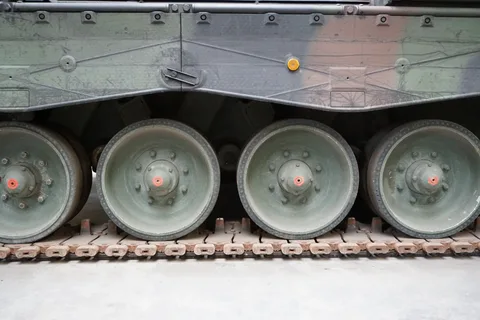 PzH 2000155 mm self-propelled howitzerSide: UkraineBuilt: Krauss-Maffei Wegmann (KNDS Deutschland) / Rheinmetall / GermanyA heavily automated tracked howitzer with high rates of fire and long-range capability. Ukraine received it from European partners for precision and high-volume artillery work.
 FH70155 mm towed howitzerSide: UkraineBuilt: VSEL / Rheinmetall / OTO Melara / United Kingdom / Germany / ItalyThe FH70 is a jointly developed British-West German-Italian 155 mm L/39 towed howitzer with an auxiliary power unit for limited self-movement. In Ukrainian service it added another NATO-standard tube-artillery option alongside M777 and CAESAR systems, giving Ukrainian artillery units a 155 mm platform documented at the front from 2022.
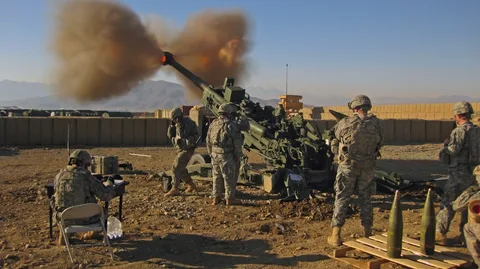 M777155 mm towed howitzerSide: UkraineBuilt: BAE Systems / United States / United KingdomA lightweight 155 mm howitzer supplied by Western partners. It gave Ukrainian artillery units broader access to NATO-standard ammunition and precision-capable fire missions.
 TRF1155 mm towed howitzerSide: UkraineBuilt: Nexter Systems / GIAT Industries / FranceThe TRF1 is a French 155 mm towed howitzer developed as a truck-towed, NATO-caliber field gun with its own auxiliary power unit for short autonomous moves. Former French systems supplied to Ukraine gave Ukrainian artillery units additional 155 mm fire-support capacity, with standard ammunition reaching about 24 km and extended-range rounds reaching roughly 30 km or more depending on ammunition type.
 AHS Krab155 mm tracked self-propelled howitzerSide: UkraineBuilt: Huta Stalowa Wola / PolandThe AHS Krab is a Polish 155 mm tracked self-propelled howitzer built by Huta Stalowa Wola around a NATO-standard 52-caliber gun, an armored tracked chassis, and modern fire-control equipment. In Ukrainian service it gives artillery units a mobile Western-caliber gun able to fire standard 155 mm ammunition, displace after missions, and operate in counter-battery-threatened sectors of the Russia-Ukraine War.
 AS-90155 mm tracked self-propelled howitzerSide: UkraineBuilt: Vickers Shipbuilding and Engineering / United KingdomThe AS-90 is a British tracked 155 mm self-propelled howitzer built for armored, mobile indirect fire support. In the Russia-Ukraine War it represents a UK-donated NATO-caliber artillery system for Ukrainian forces, combining a protected tracked chassis, 155 mm ammunition compatibility, rapid burst fire, and a conventional range of about 24.7 km.
 M109A6 Paladin155 mm tracked self-propelled howitzerSide: UkraineBuilt: United Defense (now BAE Systems Platforms & Services) / United StatesThe M109A6 Paladin is a U.S. 155 mm tracked self-propelled howitzer that added onboard navigation, automatic fire-control, digital communications, and improved crew protection to the M109 family. In Ukraine, the Paladin represents a U.S.-supplied NATO-standard artillery system for mobile indirect fire, paired in the 2023 aid package with ammunition support vehicles for sustained gun-line operations.
.jpg?width=480) CAESAR155 mm truck-mounted howitzerSide: UkraineBuilt: KNDS France / Nexter / FranceA wheeled self-propelled artillery system known for mobility and fast displacement after firing. It fits Ukraine's need for accurate fires that can quickly evade counter-battery threats.
CAESAR155 mm truck-mounted howitzerSide: UkraineBuilt: KNDS France / Nexter / FranceA wheeled self-propelled artillery system known for mobility and fast displacement after firing. It fits Ukraine's need for accurate fires that can quickly evade counter-battery threats. 2S22 Bohdana155 mm wheeled self-propelled howitzerSide: UkraineBuilt: PJSC Kramatorsk Heavy Duty Machine Tool Building Plant; Ukrainian Armor cabin integration on later variants / UkraineThe 2S22 Bohdana is Ukraine's domestic NATO-standard 155 mm wheeled self-propelled howitzer, developed around truck-mounted mobility and rapid deployment. It became one of the most visible Ukrainian-produced artillery systems of the Russia-Ukraine War after early combat use around Snake Island and later serial production supported by Ukrainian industry and foreign financing.
 Archer155 mm wheeled self-propelled howitzerSide: UkraineBuilt: BAE Systems Bofors / SwedenArcher is a Swedish 155 mm L52 wheeled self-propelled howitzer built around rapid automated firing and displacement from an armored cab. In Ukrainian service it adds NATO-caliber mobile tube artillery, with Sweden documenting both donated Archer systems and follow-on barrel support after intensive wartime use.
 Zuzana 2155 mm wheeled self-propelled howitzerSide: UkraineBuilt: Konstrukta-Defence / SlovakiaZuzana 2 is a Slovak 155 mm/52-caliber wheeled self-propelled howitzer built around an automated loading system and a Tatra 8x8 chassis. Its NATO-standard ammunition, long-range indirect-fire role, and documented deliveries to Ukraine make it part of the Western artillery support package used to strengthen Ukrainian tube artillery in the Russia-Ukraine War.
 2S7 Pion203 mm tracked self-propelled gunSide: Russia / UkraineBuilt: Leningrad Kirov Plant / Barrikady Arsenal / Soviet UnionThe 2S7 Pion is a Soviet 203 mm tracked self-propelled gun built for long-range, high-power fires against important rear-area targets. Its large 2A44 gun, tracked chassis, and rocket-assisted projectile range keep the system relevant in the Russia-Ukraine War, where both Russian and Ukrainian forces have used or reactivated Pion and Malka-family guns despite their ammunition and support burden.
 2S7M Malka203 mm tracked self-propelled gunSide: RussiaBuilt: Leningrad Kirov Plant / Barrikady / Uraltransmash / Soviet Union / RussiaThe 2S7M Malka is the modernized variant of the Soviet 2S7 Pion, a tracked 203 mm self-propelled gun built for high-power artillery missions against deep or hardened targets. The Malka upgrade increased carried ammunition and rate of fire, added newer communications and control equipment, and has been documented in Russian long-range fire and counterbattery roles during the Russia-Ukraine War.
 BM-27 Uragan220 mm self-propelled multiple launch rocket systemSide: Russia / UkraineBuilt: Splav State Research and Production Enterprise / Soviet Union / RussiaThe BM-27 Uragan is a Soviet 220 mm wheeled multiple launch rocket system built around a 16-tube launcher on the ZIL-135LM chassis. Its heavier rockets give it greater payload and range than BM-21 Grad-class systems, with warhead options including high-explosive fragmentation, cluster, and mine-scattering rounds. In the Russia-Ukraine War it remains a legacy heavy rocket artillery system used for area fires, minelaying, and counter-battery targets by forces that inherited or captured Uragan-family stocks.
 Bureviy220 mm self-propelled multiple launch rocket systemSide: UkraineBuilt: Shepetivka Repair Plant / UkraineBureviy is a Ukrainian 220 mm multiple launch rocket system that modernizes the BM-27 Uragan concept with a Tatra T815-7 8x8 chassis, digital fire-control equipment, and compatibility with Uragan-family rockets. Built by Shepetivka Repair Plant, it gives Ukrainian artillery a more mobile and networked heavy rocket launcher while retaining the 16-tube 220 mm rocket package used for area fires.
 TOS-1A Solntsepyok220 mm thermobaric multiple rocket launcherSide: Russia / UkraineBuilt: Omsktransmash (Uralvagonzavod) / RussiaThe TOS-1A Solntsepyok is a Russian tracked heavy flamethrower system that functions as a short-range thermobaric multiple rocket launcher. Built around a BM-1 launcher on a tank chassis with transporter-loaders, it fires unguided 220 mm rockets to support infantry and armor against fortified positions, vehicles, and troops in cover. In the Russia-Ukraine War it has been documented in Russian service near the front line, where its short range creates both destructive local effects and high vulnerability to Ukrainian targeting.
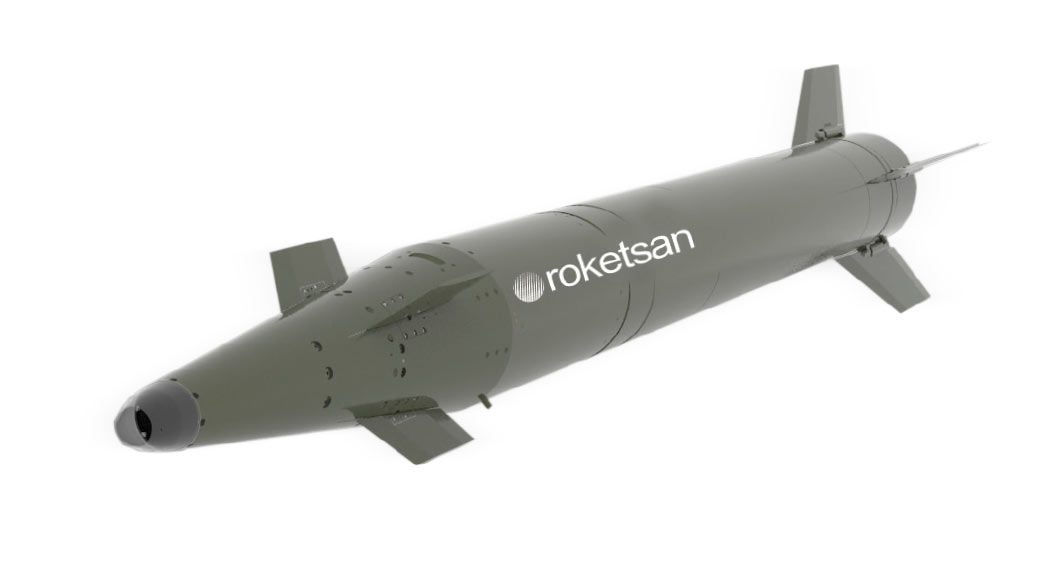 TRLG-230230 mm laser-guided artillery rocketSide: UkraineBuilt: Roketsan / TurkeyThe TRLG-230 is Roketsan's 230 mm laser-guided artillery rocket for the company's multi-caliber launcher family, combining coordinate guidance with terminal laser designation for precision strikes out to about 70 km. In the Russia-Ukraine War, open-source reporting has identified the system as a Turkish-supplied Ukrainian precision-fires capability, distinct from standard GPS-guided rockets because its laser seeker can be used against designated point targets.
 2S4 Tyulpan240 mm self-propelled heavy mortarSide: Russia / Russian-backed separatist forcesBuilt: Uraltransmash / Soviet Union / RussiaThe 2S4 Tyulpan is a Soviet 240 mm self-propelled heavy mortar built around a large breech-loaded 2B8 mortar on a tracked chassis. Its unusually heavy bombs and low rate of fire make it a siege and bunker-attack weapon rather than a conventional rapid-fire howitzer, and Russian forces have used or lost examples in Ukraine where its size and firing signature make it a high-value counter-battery target.
 Vilkha300 mm guided multiple launch rocket systemSide: UkraineBuilt: State Kyiv Design Bureau Luch / UkraineVilkha is a Ukrainian 300 mm guided rocket artillery system derived from the BM-30 Smerch family and modernized around domestically produced precision rockets. Built by State Kyiv Design Bureau Luch and associated Ukrainian defense enterprises, it gives Ukrainian rocket artillery a heavier, longer-range precision-fire option than standard unguided Smerch ammunition, with Vilkha-M extending the family beyond the baseline rocket's range.
 BM-30 Smerch300 mm heavy multiple launch rocket systemSide: RussiaBuilt: Splav State Research and Production Association / RussiaThe BM-30 Smerch, also designated 9K58, is a Soviet-designed heavy multiple launch rocket system built around a 12-tube 300 mm launcher on an 8x8 wheeled chassis. Its long-range rockets can carry high-explosive, cluster, and thermobaric warheads, making it a deep-fire artillery system rather than a front-line direct-fire weapon. In the Russia-Ukraine War, documented Russian use of 9M55K Smerch cluster rockets has tied the system to attacks on Ukrainian urban areas including Kharkiv and Mykolaiv.
 Tornado-S300 mm multiple launch rocket systemSide: RussiaBuilt: NPO Splav / Motovilikha Plants / RussiaTornado-S, also known as the 9K515 MLRS, is Russia's modernized 300 mm successor to the BM-30 Smerch, adding automated fire-control and GLONASS-aided guided rockets for longer-range precision fires. In the Russia-Ukraine War it has been documented through recovered 9M54-series guided munition remnants and reported launcher losses, making it one of Russia's higher-end rocket artillery systems in the conflict.
 2S9 NonaAir-droppable 120 mm self-propelled mortarSide: Russia / UkraineBuilt: Motovilikha Plants Corporation / Soviet Union / RussiaThe 2S9 Nona is a Soviet airborne self-propelled mortar built around a 120 mm gun-mortar on a tracked amphibious BTR-D-derived chassis. Designed to give airborne and other high-mobility units organic indirect fire, it combines mortar-style high-angle fire with limited direct-fire capability and remains documented in Russia-Ukraine War service with both Russian and Ukrainian forces.
 Kh-47M2 KinzhalAir-launched aeroballistic missileSide: RussiaBuilt: Russian Ministry of Defense / Russian defense industry / RussiaThe Kh-47M2 Kinzhal is a Russian air-launched aeroballistic missile carried by modified aircraft such as the MiG-31K. It is reported to be derived from the Iskander-M missile family and gives Russia a high-speed conventional or nuclear-capable strike option used in the Russia-Ukraine War.
 Kh-101Air-launched cruise missileSide: RussiaBuilt: A.Y. Bereznyak GosMKB Raduga JSC / RussiaThe Kh-101 is a Russian conventional air-launched cruise missile in the Kh-101/Kh-102 family, designed for long-range standoff attacks from strategic bombers. Its low-altitude flight profile, turbofan propulsion, satellite/inertial navigation, and terminal guidance make it one of Russia's principal long-range strike weapons in the Russia-Ukraine War.
 SCALP-EGAir-launched cruise missileSide: UkraineBuilt: MBDA / France / United KingdomSCALP-EG is the French-service version of the Storm Shadow/SCALP air-launched cruise missile, an MBDA deep-strike weapon built for pre-planned attacks on high-value fixed targets such as hardened facilities and key infrastructure. In Ukrainian service it added a Western long-range precision-strike option launched from adapted Su-24 aircraft during the Russia-Ukraine War.
 Storm ShadowAir-launched cruise missileSide: UkraineBuilt: MBDA / United Kingdom / FranceStorm Shadow is the UK name for the Franco-British Storm Shadow/SCALP air-launched cruise missile, a low-observable deep-strike weapon built by MBDA for precision attacks on hardened or high-value fixed targets. In the Russia-Ukraine War, UK-supplied missiles gave Ukraine a longer-range conventional strike option that was integrated onto Su-24 aircraft.
 Kh-69Air-launched land-attack cruise missileSide: RussiaBuilt: JSC Raduga State Design Bureau / Tactical Missiles Corporation / RussiaThe Kh-69 is a Russian subsonic air-launched land-attack cruise missile developed by Raduga within Tactical Missiles Corporation for precision strikes against fixed targets. It is associated with tactical aircraft such as the Su-34, Su-35, and Su-57, uses inertial, satellite, radar-altimeter, and electro-optical terminal guidance, and has been documented in Russian strikes during the Russia-Ukraine War.
 Kh-55/Kh-555Air-launched subsonic cruise missile familySide: RussiaBuilt: Raduga Design Bureau / Soviet Union / RussiaThe Kh-55/Kh-555 family is a Soviet-designed, Raduga-built air-launched cruise missile line carried by Russian strategic bombers. The original Kh-55 was a nuclear-armed standoff weapon, while the Kh-555 is a conventional derivative with improved accuracy and a reported range up to about 3,500 km. In the Russia-Ukraine War, Russian Tu-95MS bombers have launched Kh-101/Kh-555/Kh-55 missiles as part of large mixed strike packages against Ukrainian infrastructure and other targets.
 Kh-22Air-launched supersonic anti-ship cruise missileSide: RussiaBuilt: MKB Raduga / Soviet UnionThe Kh-22, NATO reporting name AS-4 Kitchen, is a large Soviet-era air-launched cruise missile built for long-range attacks on carrier groups and other major targets. Designed by Raduga for bomber carriage, it combines a liquid-fuel rocket motor, supersonic speed, and a very large conventional or nuclear warhead. In the Russia-Ukraine War, Russia has repurposed the missile family for land-attack strikes, where its anti-ship guidance heritage and heavy payload make it especially destructive when used against urban targets.
 Kh-59Air-launched tactical cruise missileSide: RussiaBuilt: Raduga Design Bureau / Tactical Missile Armament Corporation / Smolensk Aviation Plant / Soviet Union / RussiaThe Kh-59 Ovod is a Soviet/Russian air-launched tactical cruise missile family developed by Raduga for standoff strikes from tactical aircraft. Later Kh-59M, Kh-59MK, Kh-59MK2, and Kh-59MKM variants added turbojet propulsion, larger warheads, anti-ship or land-attack guidance options, and longer range. Russia has used Kh-59-series guided air-launched missiles during the Russia-Ukraine War as part of mixed missile and drone attacks.
 AGM-88 HARMAir-to-surface anti-radiation missileSide: UkraineBuilt: Raytheon Co. / United StatesThe AGM-88 HARM is a U.S. high-speed anti-radiation missile built to home on radar emissions from enemy air-defense systems. In the Russia-Ukraine War, U.S.-supplied HARMs gave Ukrainian aircraft a suppression-of-enemy-air-defenses weapon for forcing or striking Russian radar systems despite the missile's original integration with Western aircraft.
 HarpoonCoastal and anti-ship cruise missile systemSide: UkraineBuilt: The Boeing Company / United StatesHarpoon is a U.S.-origin all-weather anti-ship cruise missile family built around active radar terminal homing and sea-skimming flight. In the Russia-Ukraine War, Ukraine received land-based Harpoon coastal defense systems and adapted truck-launched RGM-84 missiles to threaten Russian surface ships operating near the Black Sea coast.
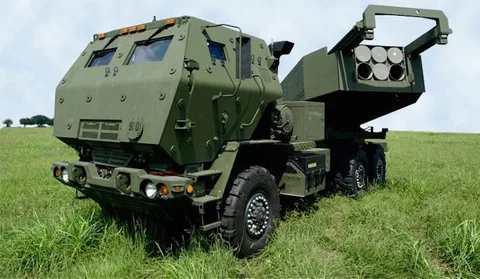 M142 HIMARSMultiple rocket launcherSide: UkraineBuilt: Lockheed Martin / United StatesA wheeled launcher used for precision strikes with guided rockets. HIMARS became one of the most visible Western systems because of its range, accuracy, and operational impact.
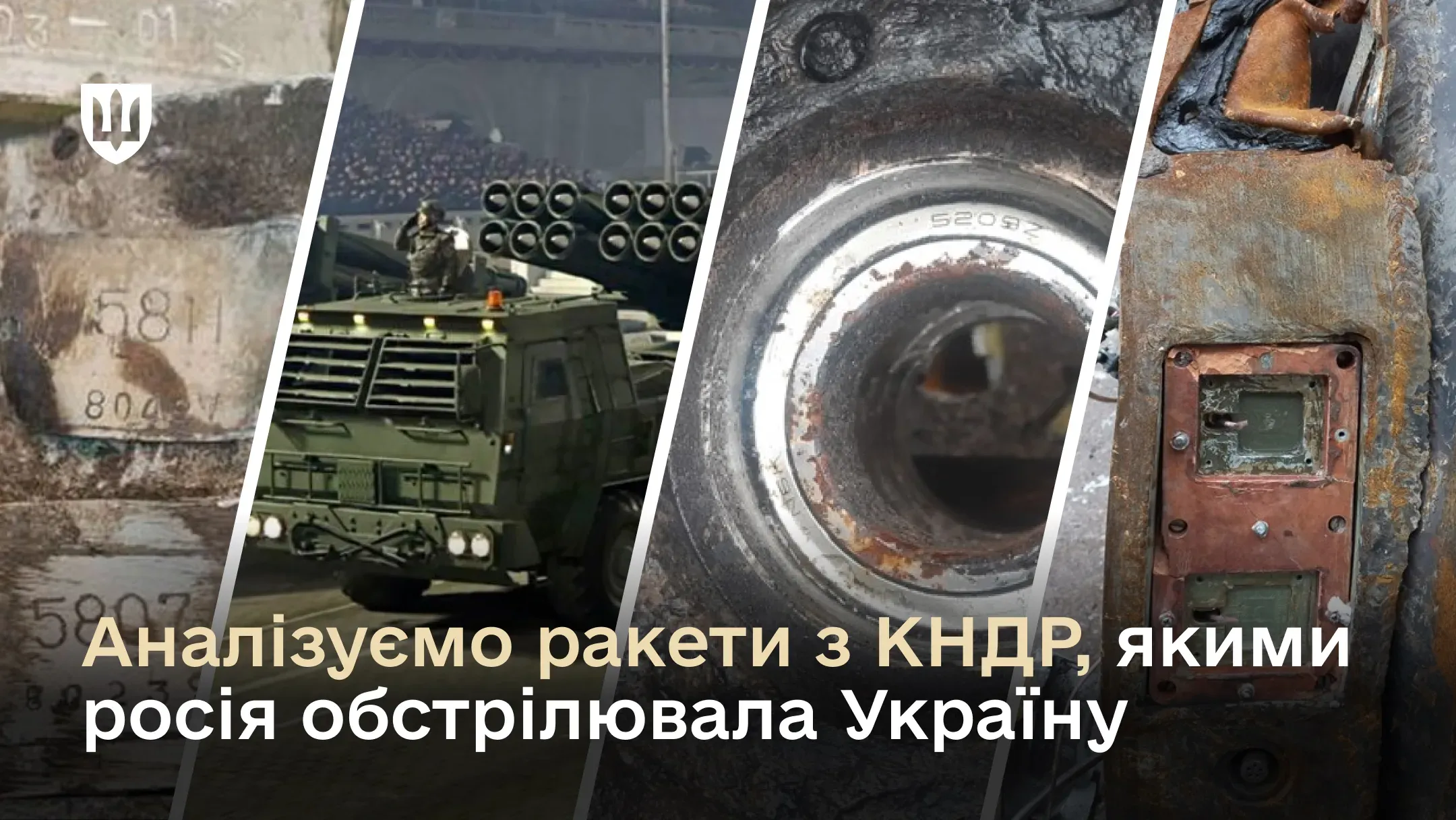 North Korean KN-23 / KN-24Road-mobile short-range ballistic missile familySide: RussiaBuilt: North Korean state arms industry; February 11 Plant attributed / North KoreaThe KN-23 and KN-24 are North Korean solid-fuel short-range ballistic missiles associated with the Hwasong-11 family. The KN-23 is a quasi-ballistic, Iskander-like system with an estimated range up to about 690 km, while the KN-24 is an ATACMS-like tactical ballistic missile assessed around 410 km. Their appearance in Russian strikes against Ukraine made them a documented example of North Korean missile proliferation into a high-intensity European war.
 9K720 IskanderRoad-mobile tactical ballistic and cruise missile systemSide: RussiaBuilt: Kolomna Machine-Building Design Bureau (KBM); Votkinsk Machine Building Plant; Production Association Barrikady / RussiaThe 9K720 Iskander is a Russian road-mobile tactical missile system that launches short-range ballistic missiles and, in Iskander-K configuration, ground-launched cruise missiles. In the Russia-Ukraine War it has served as one of Russia's principal precision-strike systems for attacks beyond the immediate front line.
 Tochka-URoad-mobile tactical ballistic missile systemSide: Russia / UkraineBuilt: Kolomna Machine Building Design Bureau (KBM) / Soviet Union / RussiaTochka-U is the upgraded 9K79-1/OTR-21 short-range tactical ballistic missile system, carried on a wheeled transporter-erector-launcher and designed for battlefield strikes with high-explosive or cluster warheads. In the Russia-Ukraine War it appears as a legacy Soviet missile system used by both sides, giving Ukraine an indigenous long-range strike option early in the invasion while also appearing in documented Russian attacks.
 KalibrSea-launched land-attack cruise missile familySide: RussiaBuilt: Novator Design Bureau / RussiaKalibr is a Russian family of ship- and submarine-launched cruise missiles, including the 3M-14 land-attack variant known to NATO as SS-N-30A. Its long range, naval basing, and conventional or reported nuclear payload options make it a central Russian Navy strike weapon, and Russian forces have repeatedly used Kalibr missiles in the Russia-Ukraine War for deep strikes against Ukrainian targets.
 Kh-32Supersonic air-launched anti-ship and land-attack cruise missileSide: RussiaBuilt: Raduga JSC, Tactical Missiles Corporation (KTRV) / RussiaThe Kh-32 is a Russian supersonic air-launched cruise missile derived from the Kh-22 family and built for long-range strikes against ships and fixed ground targets. Carried by Tu-22M3-series bombers, it combines high-altitude flight, inertial navigation, and terminal radar homing, making it part of Russia's long-range missile strike inventory used against Ukraine.
 P-800 OniksSupersonic anti-ship cruise missileSide: RussiaBuilt: NPO Mashinostroyenia / RussiaThe P-800 Oniks is a Russian supersonic anti-ship cruise missile, also associated with the Yakhont export variant and Bastion coastal launch systems. Designed for high-speed attacks against naval targets, it has also been used by Russia as a land-attack weapon against southern Ukraine, where its speed and low terminal flight profile complicate interception.
 MT-12 RapiraTowed 100 mm smoothbore anti-tank gunSide: UkraineBuilt: Yurga Machine-Building Plant / Soviet UnionThe MT-12 Rapira is a Soviet 100 mm smoothbore towed anti-tank gun that Ukraine has retained as a direct-fire and light artillery weapon. Its high-velocity gun, relatively light carriage, and existing 100 mm ammunition stocks made it useful for Ukrainian artillery and National Guard units despite its Cold War origins.
 M270 MLRSTracked multiple launch rocket systemSide: UkraineBuilt: Lockheed Martin / United StatesThe M270 MLRS is a tracked, armored multiple launch rocket system built around two launch-pod containers for guided rockets or tactical missiles. In Ukrainian service during the Russia-Ukraine War, donated M270-family launchers complement HIMARS by carrying a larger rocket load on a heavier tracked chassis for long-range precision fires.
 R-360 Neptune / Long NeptuneTruck-launched anti-ship and land-attack cruise missileSide: UkraineBuilt: State Kyiv Design Bureau Luch / UkraineThe R-360 Neptune is a Ukrainian truck-launched cruise missile developed by State Kyiv Design Bureau Luch as a coastal anti-ship system and later adapted into longer-range land-attack variants. In the Russia-Ukraine War it became one of Ukraine's most visible domestic precision-strike weapons, first for Black Sea targets such as Moskva and later through the Long Neptune / Neptune-D family reported with a 1,000 km reach.
 TOS-2 TosochkaWheeled 220 mm thermobaric multiple rocket launcherSide: RussiaBuilt: NPO Splav / RussiaThe TOS-2 Tosochka is Russia's wheeled successor to the TOS-1A heavy flamethrower system, using 220 mm thermobaric and incendiary rockets from an 18-tube launcher on a Ural 6x6 truck. Its built-in crane, automated fire-control equipment, and wheeled chassis are intended to make the system more mobile and less dependent on a separate loading vehicle, while Russian forces have fielded it during the Russia-Ukraine War.
Category
Infantry Weapons
Portable weapons used by soldiers and small units.
 AK-125.45 mm assault rifleSide: Russia / UkraineBuilt: Kalashnikov Concern / RussiaThe AK-12 is a Russian 5.45x39 mm assault rifle developed by Kalashnikov Concern as a modernized service weapon with improved ergonomics, accessory rails, optical-sight compatibility, and an adjustable folding stock. In the Russia-Ukraine War it appears as a Russian frontline small arm, while captured examples became visible in Ukrainian hands during the opening phase of the 2022 invasion.
 AK-74M5.45 mm assault rifleSide: RussiaBuilt: Kalashnikov Concern / RussiaThe AK-74M is the modernized Russian production model of the AK-74 family, chambered for 5.45x39 mm ammunition with black polymer furniture and a left-folding stock. In the Russia-Ukraine War it remains a baseline infantry rifle for Russian regular units, even as AK-12 rifles supplement it and older AKM rifles appear among mobilized troops.
 PKM/PK7.62 mm general-purpose machine gunSide: UkraineBuilt: Kovrov Mechanical Plant and licensed producers / Soviet Union, Russia, and licensed-production countriesThe PK and lighter PKM are Soviet-designed, belt-fed 7.62x54R general-purpose machine guns used from bipods, tripods, vehicles, and improvised mounts. Their low weight for the class, non-disintegrating belt feed, quick-change barrel concept, and wide Warsaw Pact distribution make the family a common infantry fire-support weapon in the Russia-Ukraine War, where Ukrainian units continue to operate PKM-pattern guns alongside newer and foreign-supplied machine guns.
 PKP Pecheneg7.62 mm general-purpose machine gunSide: Russia / UkraineBuilt: TsNIITochMash / Degtyaryov Plant / RussiaThe PKP Pecheneg is a Russian 7.62x54mmR belt-fed machine gun derived from the PKM but built around a heavier forced-air-cooled barrel and forward bipod for sustained squad fire. It remains a Russian infantry support weapon and has also appeared in Ukraine, including separatist use reported during the Donbas phase of the war and later Ukrainian use of captured examples.
 AKM7.62x39mm assault rifleSide: Ukraine / Russian-backed separatist forcesBuilt: Izhmash / licensed manufacturers / Soviet Union / licensed producersThe AKM is the stamped-receiver modernization of the Soviet Kalashnikov assault rifle, chambered for 7.62x39mm and built around a long-stroke gas piston and rotating bolt. Its lower production burden, broad Warsaw Pact and licensed manufacture, and large legacy stocks keep it visible in the Russia-Ukraine War, where Ukrainian personnel have trained with AKM rifles and CAR documented AKM examples recovered from Russian-backed formations in eastern Ukraine.
 DShK12.7 mm heavy machine gunSide: UkraineBuilt: Tula Ordnance Factory / Soviet state arsenals / Soviet UnionThe DShK is a Soviet 12.7 mm heavy machine gun designed by Vasily Degtyaryov and refined with Georgy Shpagin's belt-feed system. Built for anti-aircraft, anti-vehicle, and infantry support roles, the weapon remains relevant in Ukraine because inherited DShK and DShKM guns can be adapted for trench support or mounted in mobile air-defense teams against slow Russian drones.
 NSV12.7 mm heavy machine gunSide: RussiaBuilt: Metallist JSC / West Kazakhstan Machine-Building Company / Soviet Union / KazakhstanThe NSV Utes is a Soviet 12.7x108 mm heavy machine gun designed by Nikitin, Sokolov, and Volkov as a lighter replacement for older heavy machine guns. It can be used from a tripod, vehicle mount, or remote station against light armor, firing points, personnel, and low-flying aerial targets; in the Russia-Ukraine War it remains relevant because legacy stocks and vehicle-mounted NSVT variants continue to appear on battlefield equipment.
 KPV14.5 mm heavy machine gunSide: UkraineBuilt: V. A. Degtyarev Plant (ZiD) / Soviet Union / RussiaThe KPV is a Soviet 14.5x114 mm heavy machine gun designed by Semyon Vladimirov and produced at the V. A. Degtyarev Plant. Its high-energy cartridge made it useful against light armor, field positions, small craft, and low-flying aircraft, so the family spread from the original infantry gun into KPVT vehicle guns, ZPU anti-aircraft mounts, and modern improvised mounts seen in the Russia-Ukraine War.
.jpg?width=480) SPG-973 mm tripod-mounted recoilless gunSide: UkraineBuilt: Soviet state arsenals / Arsenal / Romarm / Soviet Union / Bulgaria / RomaniaThe SPG-9 is a Soviet 73 mm tripod-mounted recoilless gun that fires rocket-assisted HEAT and fragmentation projectiles from a crew-served launcher. Though designed as an infantry anti-armor weapon, Ukrainian units have documented its continued use in the Russia-Ukraine War as a flexible fire-support system against trenches, infantry groups, and light armored vehicles.
SPG-973 mm tripod-mounted recoilless gunSide: UkraineBuilt: Soviet state arsenals / Arsenal / Romarm / Soviet Union / Bulgaria / RomaniaThe SPG-9 is a Soviet 73 mm tripod-mounted recoilless gun that fires rocket-assisted HEAT and fragmentation projectiles from a crew-served launcher. Though designed as an infantry anti-armor weapon, Ukrainian units have documented its continued use in the Russia-Ukraine War as a flexible fire-support system against trenches, infantry groups, and light armored vehicles. TM-62Anti-tank blast mineSide: Russia / UkraineBuilt: Various Soviet and Russian state manufacturers / Soviet Union / RussiaThe TM-62 is a Soviet family of circular anti-tank blast mines built around a central fuze and a large high-explosive charge. The metal-cased TM-62M and plastic-cased TM-62P3 variants are documented in the Russia-Ukraine War, where both sides have used anti-vehicle mines extensively to block routes, defend positions, and contaminate farmland and approaches.
 BrimstoneAnti-tank guided missileSide: UkraineBuilt: MBDA UK / United KingdomBrimstone is a British MBDA precision-guided anti-armor missile built around millimetric-wave radar guidance, with later variants adding semi-active laser and inertial navigation options. In Ukraine it has been adapted from its original air-launched role into a donated ground-launched anti-tank capability for striking Russian armor and formations.
 FGM-148 JavelinAnti-tank guided missileSide: UkraineBuilt: Javelin Joint Venture (Lockheed Martin / Raytheon) / United StatesA portable anti-armor missile known for top-attack profiles and fire-and-forget guidance. It became a symbol of early international military support to Ukraine.
 PMN-1/2/4Antipersonnel blast mine familySide: RussiaBuilt: Soviet and Russian state munitions plants / Soviet Union / RussiaThe PMN-1/2/4 family covers Soviet and Russian pressure-activated antipersonnel blast mines used to deny foot movement and injure personnel at close range. PMN-1 and PMN-2 are Soviet designs, while PMN-4 is a later Russian circular plastic-cased mine; all three are relevant to mine-contamination reporting in and around Ukraine, where PMN-2 and PMN-4 examples have been documented during the Russia-Ukraine War.
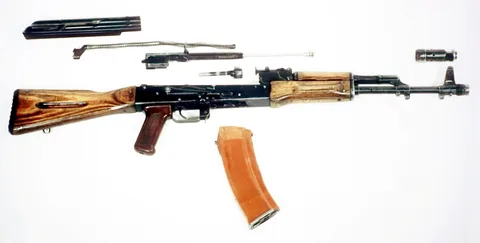 AK-74Assault rifleSide: UkraineBuilt: Izhmash / Kalashnikov Concern / Soviet Union / RussiaA 5.45 mm assault rifle family that remains a common Ukrainian service weapon. It appears in many variants, including folding-stock and modernized configurations.
 OZM-72Bounding antipersonnel fragmentation mineSide: RussiaBuilt: Factory 583 / Soviet state arsenals / Soviet Union / RussiaThe OZM-72 is a Soviet-designed bounding antipersonnel fragmentation mine that ejects from its casing before detonation, projecting fragments around the burst point. In the Russia-Ukraine War, Human Rights Watch has documented OZM-72 mines among Russian antipersonnel mine use, making the system part of Ukraine's wider explosive-ordnance clearance problem in retaken areas.
 MalyukBullpup assault rifleSide: UkraineBuilt: InterProInvest / UkraineA Ukrainian bullpup rifle derived from Kalashnikov-pattern mechanics. It is associated with special operations and domestic small-arms development.
 MON-100Directional anti-personnel fragmentation mineSide: RussiaBuilt: Soviet and Russian state arsenals, exact plant not identified in open sources / USSR and RussiaThe MON-100 is a Soviet/Russian directional anti-personnel fragmentation mine, a larger member of the MON family intended to project steel fragments across a 100-meter danger area. In the Russia-Ukraine War it appears in mine-action reporting as one of the MON-series mines used by Russian forces, adding to the hand-emplaced and tripwire or command-initiated explosive hazards facing Ukrainian deminers and civilians.
 MON-90Directional fragmentation anti-personnel mineSide: RussiaBuilt: Soviet state arsenals / Bulgarian production / Soviet Union / BulgariaThe MON-90 is a Soviet-designed directional fragmentation anti-personnel mine, broadly comparable in role to a large Claymore-type munition. It uses a plastic, curved body and a heavy explosive charge to project steel fragments across a fixed arc, and open-source mine-action reporting identifies it among the antipersonnel mines contaminating Ukrainian territory during the Russia-Ukraine War.
 MON-50Directional fragmentation antipersonnel mineSide: RussiaBuilt: Soviet/Russian defense industry / Soviet Union / Russia / BulgariaThe MON-50 is a Soviet directional fragmentation antipersonnel mine broadly comparable in role to the M18 Claymore, with a plastic body, folding legs, and a forward fragmentation pattern. It can be command-detonated or configured with tripwire and other fuzing, making it a compact infantry obstacle and ambush munition. In the Russia-Ukraine War, monitoring groups identify MON-50 mines among Russian-used hand-emplaced antipersonnel mines, adding to the dense explosive contamination faced by Ukrainian deminers and civilians.
 RPG-18Disposable anti-tank rocket launcherSide: UkraineBuilt: State Research and Production Enterprise Bazalt / Soviet UnionThe RPG-18 Mukha is a Soviet disposable, shoulder-fired anti-tank rocket launcher built around a telescoping launch tube and a 64 mm PG-18 HEAT rocket. It gives small infantry teams a lightweight short-range anti-armor weapon, and in Ukraine it appears both as a carried legacy launcher and as an improvised payload on FPV drones.
 RPG-26Disposable anti-tank rocket launcherSide: Russia / Ukraine-linked armed formationsBuilt: NPO Bazalt / RussiaThe RPG-26 is a Soviet-designed disposable 72.5 mm anti-tank rocket launcher built around a single HEAT rocket in a sealed launch tube. Its low carried weight, simple pre-fire procedure, and short-range armor and fortification defeat role made it a common infantry anti-armor weapon, with documented circulation in the Russia-Ukraine War.
_(cropped)_RPG-27.jpg?width=480) RPG-27 TavolgaDisposable anti-tank rocket launcherSide: Russian-backed separatists / RussiaBuilt: JSC SPA Bazalt / Soviet Union / RussiaThe RPG-27 Tavolga is a Soviet/Russian disposable 105 mm anti-tank rocket launcher built around a tandem HEAT warhead for defeating ERA-protected armor and field fortifications. It is heavier than earlier RPG-26-class disposable launchers but remains portable by one soldier, and open reporting documented its use by Russian-backed forces against Ukrainian positions in Donbas during the Russia-Ukraine War.
RPG-27 TavolgaDisposable anti-tank rocket launcherSide: Russian-backed separatists / RussiaBuilt: JSC SPA Bazalt / Soviet Union / RussiaThe RPG-27 Tavolga is a Soviet/Russian disposable 105 mm anti-tank rocket launcher built around a tandem HEAT warhead for defeating ERA-protected armor and field fortifications. It is heavier than earlier RPG-26-class disposable launchers but remains portable by one soldier, and open reporting documented its use by Russian-backed forces against Ukrainian positions in Donbas during the Russia-Ukraine War. RPG-30Disposable anti-tank rocket-propelled grenade launcherSide: Russia / Ukraine (captured examples)Built: NPO Bazalt / RussiaThe RPG-30 Kryuk is a Russian disposable shoulder-fired anti-tank launcher built around a dual-tube concept: a small precursor projectile is fired ahead of the 105 mm tandem HEAT round to complicate active protection systems before the main warhead arrives. In Ukraine it has appeared primarily as a Russian infantry anti-armor weapon, with captured examples also documented in Ukrainian hands.
 MATADORDisposable shoulder-fired anti-armor recoilless weaponSide: UkraineBuilt: Dynamit Nobel Defence / ST Engineering / Germany / SingaporeMATADOR, also fielded in German service and export lists as RGW 90, is a 90 mm man-portable disposable recoilless weapon for infantry anti-armor and anti-structure work. Its dual HEAT/HESH effect, confined-space firing capability, and light one-soldier operation made it a relevant close-range weapon for Ukrainian units after Germany and industry channels supplied RGW 90 launchers during the Russia-Ukraine War.
 RPG-22Disposable shoulder-fired anti-tank rocket launcherSide: RussiaBuilt: Bazalt / VMZ Sopot / Soviet Union / Russia / BulgariaThe RPG-22 Netto is a Soviet disposable anti-tank rocket launcher developed as a larger-caliber successor to the RPG-18, firing a 72.5 mm PG-22 HEAT rocket from a telescoping fiberglass launch tube. Its light single-shot format made it a common short-range infantry anti-armor weapon in Soviet and post-Soviet stocks, and ARES documented an RPG-22 among weapons seized from alleged Russian saboteurs during the opening days of Russia's 2022 full-scale invasion of Ukraine.
.jpg?width=480) M136 AT4Disposable shoulder-fired light anti-armor recoilless weaponSide: UkraineBuilt: FFV Ordnance / Saab Bofors Dynamics / Alliant Techsystems / Sweden / United StatesThe M136 AT4 is the U.S. designation for an Americanized Saab AT4, a single-shot 84 mm shoulder-fired anti-armor weapon issued as a disposable launch tube. It gives infantry a lightweight close-range option against light armor, bunkers, gun positions, and buildings, and Ukraine has received AT-4 systems through U.S. security assistance during the Russia-Ukraine War.
M136 AT4Disposable shoulder-fired light anti-armor recoilless weaponSide: UkraineBuilt: FFV Ordnance / Saab Bofors Dynamics / Alliant Techsystems / Sweden / United StatesThe M136 AT4 is the U.S. designation for an Americanized Saab AT4, a single-shot 84 mm shoulder-fired anti-armor weapon issued as a disposable launch tube. It gives infantry a lightweight close-range option against light armor, bunkers, gun positions, and buildings, and Ukraine has received AT-4 systems through U.S. security assistance during the Russia-Ukraine War. RPO-A ShmelDisposable shoulder-fired thermobaric rocket launcherSide: RussiaBuilt: KBP Instrument Design Bureau / RussiaThe RPO-A Shmel is a Soviet-designed, Russian-produced disposable infantry rocket launcher built around a 93 mm thermobaric round for attacking troops, firing points, light vehicles, and fortified positions at short range. Although Russian doctrine classifies it as a rocket-assisted flamethrower, its battlefield effect comes from a fuel-air explosive warhead rather than a projected liquid flame, making it relevant to documented Russian close-assault firepower in the Russia-Ukraine War.
 AKMSFolding-stock 7.62x39mm assault rifleSide: RussiaBuilt: Izhmash / Soviet UnionThe AKMS is the under-folding-stock variant of the Soviet AKM assault rifle, retaining the AKM's stamped receiver, gas-operated selective-fire action, and 7.62x39mm chambering while giving airborne, vehicle-mounted, and compact-carry users a shorter folded profile. In the Russia-Ukraine War, ARES documented a specific AKMS seized by Ukrainian police from an alleged Russian saboteur, illustrating how older Kalashnikov-pattern rifles still appear alongside newer small arms.
 BGM-71 TOWHeavy anti-tank guided missileSide: UkraineBuilt: Hughes Aircraft Company / Raytheon / United StatesThe BGM-71 TOW is a U.S. heavy anti-tank guided missile built around tube launch, optical tracking, and command guidance through a wire or later radio-frequency link. Developed by Hughes and now produced and upgraded by Raytheon, it can be fired from dismounted launchers, HMMWVs, Bradley and Stryker vehicles, light armored vehicles, and helicopters, giving infantry and vehicle crews a long-range precision anti-armor weapon. In the Russia-Ukraine War, U.S. security assistance packages sent TOW missiles to Ukraine as part of the anti-armor mix used to offset Russian armored forces.
 9M133 KornetLaser beam-riding anti-tank guided missile systemSide: Russia / pro-Russian separatists / Ukraine (captured)Built: KBP Instrument Design Bureau / RussiaThe 9M133 Kornet is a Russian heavy anti-tank guided missile system using laser beam-riding guidance and tandem HEAT or thermobaric warheads. Developed by KBP as a portable and vehicle-integrated ATGM family, it appears in the Russia-Ukraine War as a Russian-origin system documented with pro-Russian forces and also captured by Ukrainian troops.
 MILANMan-portable anti-tank guided missileSide: UkraineBuilt: Euromissile / MBDA / France / GermanyMILAN is a Franco-German, wire-guided anti-tank guided missile built around a reusable launch post and disposable missile round. Designed for infantry anti-armor teams, the SACLOS system requires the operator to keep the sight on target while guidance commands travel through a wire link. France has documented MILAN systems among the anti-tank weapons delivered to Ukraine for the Russia-Ukraine War.
 9K111 FagotMan-portable anti-tank guided missile systemSide: RussiaBuilt: KBP Instrument Design Bureau / Soviet UnionThe 9K111 Fagot, known to NATO as the AT-4 Spigot, is a Soviet man-portable SACLOS wire-guided anti-tank missile system built around the 9P135 tripod launcher and 9M111 missile family. Its compact launcher, vehicle-mount compatibility, and 2 to 2.5 km range kept it relevant for legacy users, including Russian anti-tank teams documented in the Russia-Ukraine War.
 9K115 MetisMan-portable anti-tank guided missile systemSide: RussiaBuilt: KBP Instrument Design Bureau / Soviet Union / RussiaThe 9K115 Metis is a Soviet/Russian man-portable, wire-guided anti-tank guided missile family developed for company-level infantry anti-armor fire. The original AT-7 Saxhorn system emphasized a light launcher and short-range portability, while the later 9K115-2 Metis-M and Metis-M1 variants use larger 130 mm missiles, tandem HEAT or thermobaric warheads, and ranges up to 2 km. In the Russia-Ukraine War, Russian forces have been documented using the upgraded AT-13 Saxhorn-2 / Metis-M variant against Ukrainian armor.
 Skif/Stugna-PMan-portable anti-tank guided missile systemSide: UkraineBuilt: State Kyiv Design Bureau Luch / UkraineSkif, known in Ukrainian service as Stugna-P, is a Ukrainian laser-beam-riding anti-tank guided missile system from Luch Design Bureau. Its separated remote-control panel lets crews guide missiles from cover, and its 130 mm or 152 mm missiles give Ukrainian infantry and mobile teams a long-range anti-armor weapon in the Russia-Ukraine War.
 RK-3 CorsarPortable anti-tank guided missile systemSide: UkraineBuilt: State Kyiv Design Bureau Luch / UkraineThe RK-3 Corsar is a Ukrainian 107 mm portable anti-tank guided missile system from Luch, built for small-unit anti-armor work with laser-beam guidance, a 2.5 km maximum range, and RK-3K tandem HEAT or RK-3OF high-explosive fragmentation missiles. Ukrainian forces have used the system during the Russia-Ukraine War against Russian armored vehicles, giving infantry and National Guard teams a compact domestically produced ATGM alongside heavier systems such as Stugna-P.
 9K114 ShturmRadio-command anti-tank guided missile systemSide: Russia / UkraineBuilt: KBM Kolomna / Soviet Union / RussiaThe 9K114 Shturm is a Soviet radio-command anti-tank guided missile system built around the 9M114 Kokon missile and known to NATO as AT-6 Spiral. Designed by KBM Kolomna for attack helicopters and the MT-LB-based 9P149 Shturm-S carrier, it combines SACLOS guidance, a fast missile, and a roughly 5 km baseline range. In the Russia-Ukraine War, Russian 9P149 vehicles have been captured or displayed as battlefield trophies, while Ukrainian units have shown Shturm-S use and modernization efforts to keep the system relevant for anti-armor missions.
 RPG-7Reusable shoulder-fired anti-tank rocket launcherSide: UkraineBuilt: Multiple state and licensed producers / Soviet Union / Russia / China / Bulgaria / Iraq / Iran / Pakistan / Romania / EgyptThe RPG-7 is a Soviet-origin reusable shoulder-fired rocket launcher built around a simple 40 mm launch tube and a wide family of over-caliber anti-armor, fragmentation, and thermobaric rounds. Its low cost, portability, and large global stock make it a common infantry anti-armor and assault weapon, including in Ukrainian service during the Russia-Ukraine War.
 RPG-29Reusable shoulder-fired anti-tank rocket launcherSide: Russian and separatist forcesBuilt: Bazalt / Soviet Union / RussiaThe RPG-29 Vampir is a Soviet-designed, reusable 105 mm anti-tank rocket launcher built around tandem HEAT and thermobaric rockets. Its long launch tube, optical sight, and PG-29V tandem warhead give infantry a portable short-range weapon intended to attack armored vehicles and fortifications, and ARES documentation places the system in the Russia-Ukraine War's 2014 eastern Ukraine fighting.
 RPG-32Reusable shoulder-fired anti-tank rocket launcherSide: UkraineBuilt: NPO Bazalt / JADARA Equipment & Defence Systems / Russia / JordanThe RPG-32 is a Russian-designed, Jordan-assembled reusable anti-tank rocket launcher built around a compact firing unit and disposable launch containers. It can fire 105 mm anti-tank and thermobaric rounds, giving small units a portable close-range weapon against armor, field fortifications, buildings, and personnel in cover. Open-source reporting placed Jordanian Nashshab-marked RPG-32 launchers in Ukrainian hands during the Russia-Ukraine War, with the exact delivery channel remaining unclear.
 9M113 KonkursSACLOS wire-guided anti-tank guided missileSide: Russia / Ukraine-aligned forcesBuilt: KBP Instrument Design Bureau / Tula Arms Plant / Soviet Union / RussiaThe 9M113 Konkurs, NATO reporting name AT-5 Spandrel, is a Soviet wire-guided anti-tank guided missile family built for infantry launchers and vehicle mounts such as BMP-series vehicles and the BRDM-2-based 9P148. Its SACLOS guidance, 135 mm missile body, and 4 km class engagement range kept it useful after the Cold War, including documented employment in the Russia-Ukraine War by Ukrainian-aligned forces and Russian units.
 PFM-1Scatterable anti-personnel blast mineSide: Ukraine (apparent use)Built: Soviet state arsenals / Soviet UnionThe PFM-1 is a Soviet scatterable anti-personnel blast mine with a plastic winged body and a small liquid-explosive charge, designed for remote delivery rather than hand emplacement. In the Russia-Ukraine War it has been documented in PFM-series rocket-scattered mine contamination around Izium, where Human Rights Watch linked the mines to 220 mm Uragan mine-laying rockets and civilian casualties.
 PTM-1Scatterable anti-vehicle mineSide: Russia / UkraineBuilt: Soviet/Russian state arsenals / Soviet Union / RussiaThe PTM-1 is a Soviet/Russian plastic-bodied scatterable anti-vehicle blast mine intended for remote delivery by rocket artillery, helicopter, or aircraft dispensers rather than manual emplacement. In the Russia-Ukraine War it appears in documented anti-vehicle mine use, with Human Rights Watch listing PTM-1/PTM-1G mines among types stockpiled by both Russia and Ukraine.
 POM-2Scatterable antipersonnel fragmentation mineSide: RussiaBuilt: Soviet/Russian state munitions industry / Soviet Union / RussiaThe POM-2 is a Soviet/Russian scatterable antipersonnel fragmentation mine that deploys tripwire sensors after delivery by rockets, helicopters, aircraft, vehicles, or specialized dispensers. In Ukraine, it appears as part of Russia's remotely delivered mine threat, including documented POM-2 mines and KPOM-2 canisters recovered in areas cleared by Ukrainian emergency services.
 PTM-4MScatterable magnetic-influence anti-vehicle mineSide: RussiaBuilt: AO NIII (Scientific Research Engineering Institute) / RussiaThe PTM-4M is a Russian scatterable anti-vehicle mine from the PTM-4 family, using a shaped-charge warhead and magnetic-influence fuzing for remote minefield emplacement. Human Rights Watch documented a PTM-4M-marked delivery canister in Kharkiv Oblast in May 2022, and mine-monitoring sources list the type among Russian antivehicle mines used during the Russia-Ukraine War.
 SVDSemi-automatic designated marksman rifleSide: Russia / UkraineBuilt: Izhevsk Machine-Building Plant / Kalashnikov Concern / Soviet Union / RussiaThe SVD, commonly known as the Dragunov, is a Soviet 7.62x54R semi-automatic designated marksman rifle designed to give infantry squads longer-range precision fire without the weight and slower rate of a bolt-action sniper rifle. It remains relevant in the Russia-Ukraine War because both Russian and Ukrainian forces inherited large stocks, while Russia has continued to field and procure Dragunov-family rifles despite newer replacement programs.
 TM-72Shaped-charge anti-tank mineSide: Russia / UkraineBuilt: Unknown Soviet state manufacturer / Soviet Union / Russian FederationThe TM-72 is a Soviet metal-cased anti-tank mine built around a shaped-charge effect and magnetic-influence fuzing, rather than a simple pressure blast. In Ukraine it is documented less often than common TM-62-series mines, but open reporting in 2026 described both limited battlefield use and Russian efforts to employ TM-72 mines in contested urban approaches.
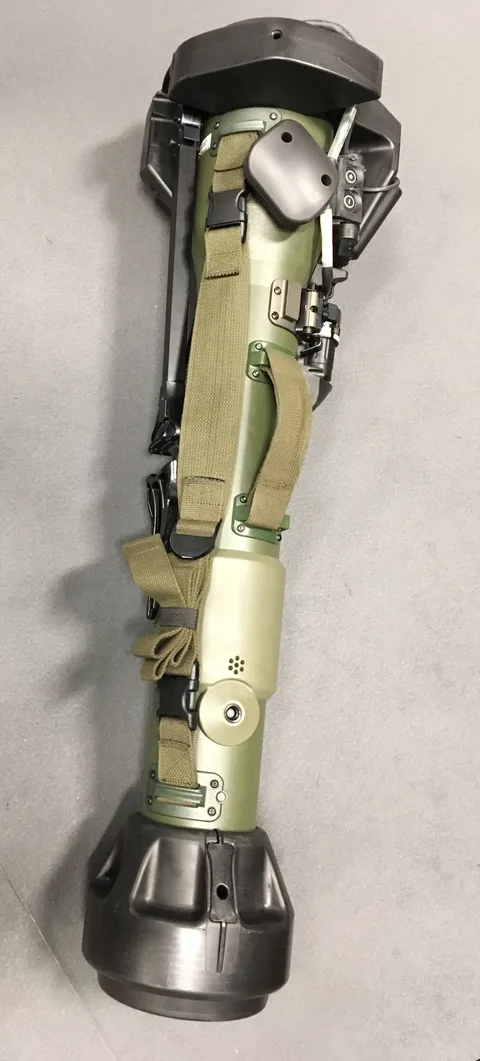 NLAWShort-range anti-tank weaponSide: UkraineBuilt: Saab Bofors Dynamics / Thales Air Defence / Sweden / United KingdomA shoulder-fired anti-tank weapon supplied in large numbers before and after the 2022 full-scale invasion. Its simple employment made it valuable for infantry ambushes.
 RPK/RPK-74Squad automatic weapon / light machine gunSide: Russia-aligned forcesBuilt: Vyatskiye Polyany Machine-Building Plant Molot / Soviet Union / RussiaThe RPK and RPK-74 are Kalashnikov-pattern squad automatic weapons that extend the AK family with a longer, heavier barrel, bipod, and higher-capacity magazines for sustained fire by infantry sections. The 7.62 x 39 mm RPK paralleled the AKM, while the 5.45 x 39 mm RPK-74 followed the AK-74; both remain relevant in the Russia-Ukraine War because legacy Soviet and Russian stocks continue to appear in front-line small-arms holdings.
Category
Tanks
Heavy armor built around direct fire, protection, and battlefield shock.
 Challenger 2Main battle tankSide: UkraineBuilt: Vickers Defence Systems / BAE Systems Land & Armaments / Rheinmetall BAE Systems Land / United KingdomThe Challenger 2 is a British third-generation main battle tank built around a rifled 120 mm gun, heavy composite armor, and four-person crew operations. In the Russia-Ukraine War, the United Kingdom supplied a small squadron to Ukraine as one of the first Western main battle tank transfers of the full-scale invasion.
 Leopard 1A5Main battle tankSide: UkraineBuilt: KNDS Deutschland / GermanyThe Leopard 1A5 is a German main battle tank modernization centered on improved fire control, thermal sighting, and the 105 mm L7-series gun. In the Russia-Ukraine War, refurbished A5-family tanks from European industrial stocks give Ukrainian armored units a lighter Western tank with good mobility and logistics support, but less passive protection than newer Leopard 2 variants.
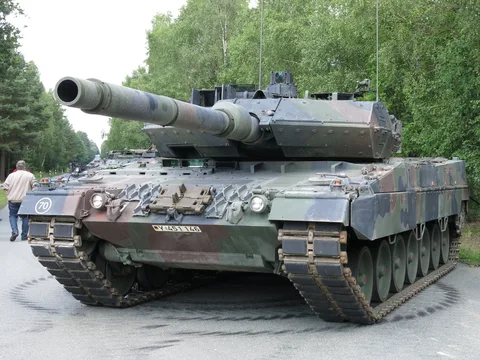 Leopard 2Main battle tankSide: UkraineBuilt: Krauss-Maffei Wegmann (KNDS Deutschland) / Rheinmetall / GermanyA Western main battle tank supplied by European partners. Its arrival marked a major shift in Ukraine's armored force mix toward NATO-standard logistics, optics, and fire-control systems.
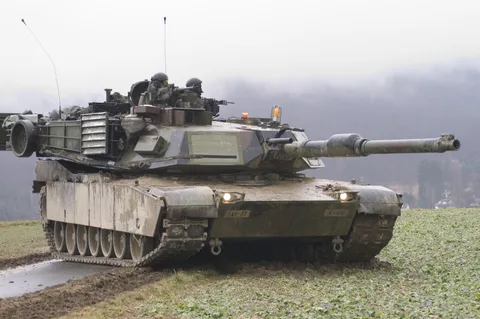 M1 AbramsMain battle tankSide: UkraineBuilt: General Dynamics Land Systems / United StatesA U.S. main battle tank transferred to Ukraine. It brings heavy protection, advanced sensors, and a demanding sustainment footprint compared with older Soviet-pattern fleets.
 PT-91 TwardyMain battle tankSide: UkraineBuilt: Bumar-Labedy / PolandThe PT-91 Twardy is a Polish main battle tank developed from the T-72M1 with domestic upgrades including ERAWA explosive reactive armor, improved fire-control equipment, and an 850 hp diesel powerpack. In the Russia-Ukraine War it represents a Polish-supplied T-72-family tank type used to expand Ukraine's armored force with a familiar three-crew, autoloaded 125 mm platform.
 Strv 122Main battle tankSide: UkraineBuilt: Krauss-Maffei Wegmann / Bofors Defense / Alvis Hagglunds / Germany / SwedenThe Strv 122 is Sweden's upgraded Leopard 2 main battle tank, adapted for Swedish service with reinforced protection, Swedish communications, smoke launchers, and a four-person crew. Sweden transferred ten tanks to Ukraine in 2023, pairing the donation with training for Ukrainian crews before the vehicles were fielded in the Russia-Ukraine War.
 T-62Main battle tankSide: RussiaBuilt: Uralvagonzavod / Soviet UnionThe T-62 is a Soviet main battle tank built around a 115 mm smoothbore gun, a four-person crew, and conventional tracked armor layout. Designed by the Uralvagonzavod design bureau as a successor to the T-54/T-55 family, it became a major Cold War Soviet tank and later reappeared in Russia's war against Ukraine as older T-62M and T-62MV variants were pulled from storage to supplement Russian armored forces.
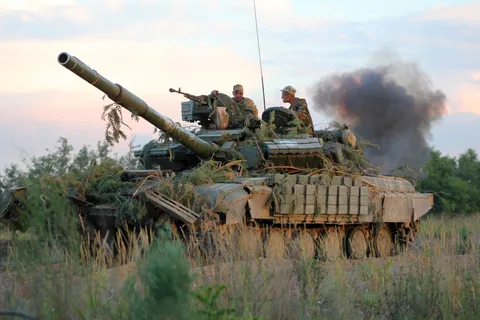 T-64BVMain battle tankSide: UkraineBuilt: Malyshev Factory / Soviet tank plants / Ukraine / Soviet UnionA core Ukrainian tank family, often seen with explosive reactive armor and local modernization packages. The T-64 lineage remains important because Ukraine inherited deep experience maintaining and upgrading it.
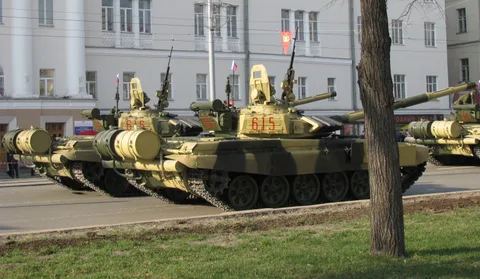 T-72Main battle tankSide: UkraineBuilt: Uralvagonzavod and licensed producers / Soviet Union / Russia / licensed producersA widely used Soviet-designed tank operated in several variants. Ukraine fields inherited, captured, and donated T-72s, making the family one of the war's most recognizable armored vehicles.
 T-80Main battle tankSide: Russia / UkraineBuilt: Leningrad Kirov Plant / Omsktransmash / Malyshev Factory / Soviet Union / Russia / UkraineThe T-80 is a Soviet-designed main battle tank built around a compact three-man layout, autoloaded 125 mm gun, and gas-turbine mobility in most major variants. In the Russia-Ukraine War it appears on both sides: Russia has deployed T-80BV, T-80U, and T-80BVM-family tanks, and Ukraine has operated captured Russian T-80s alongside its own armored forces.
 T-84 OplotMain battle tankSide: UkraineBuilt: Malyshev Plant / Kharkiv Morozov Machine Building Design Bureau / UkraineThe T-84 Oplot is a Ukrainian main battle tank developed from the diesel-engined T-80UD line, combining a three-person crew, autoloaded 125 mm gun, 1,200 hp diesel powerpack, explosive reactive armor, and Ukrainian fire-control upgrades. Produced in very small numbers for Ukraine compared with export production, the BM Oplot variant has been documented in Ukrainian combat service during the Russia-Ukraine War.
 T-90MMain battle tankSide: RussiaBuilt: Uralvagonzavod / RussiaThe T-90M Proryv is Russia's upgraded T-90 main battle tank, combining a revised turret, 125 mm gun, Relikt explosive reactive armor, modernized sights, and improved mobility. In the Russia-Ukraine War it appears as one of Russia's most modern operational tanks, with visually documented battlefield losses and captures.
 T-54/T-55Main battle tank / medium tank familySide: RussiaBuilt: Uralvagonzavod; Kharkiv Locomotive Factory; licensed production in Poland and Czechoslovakia / Soviet Union; Poland; CzechoslovakiaThe T-54/T-55 is a Soviet tank family built around a low-profile tracked hull, four-person crew, and 100 mm D-10-series gun. It became one of the most widely produced tank families of the Cold War, with Soviet and licensed production spreading across Warsaw Pact and partner states. In the Russia-Ukraine War, its renewed appearance with Russian forces has been notable because it illustrates Russia drawing on very old armored reserves for secondary fire-support or positional roles rather than fielding a modern main battle tank capability.
 M-55SUpgraded T-55 main battle tankSide: UkraineBuilt: ST Ravne / SloveniaThe M-55S is Slovenia's modernized T-55 main battle tank, rebuilt by ST Ravne with a 105 mm gun, explosive reactive armor, fire-control upgrades, laser-warning equipment, and NATO-compatible ammunition. During the Russia-Ukraine War, Slovenia committed 28 M-55S tanks to Ukraine through a ring exchange with Germany, making the type a legacy Soviet chassis adapted for Western-supported Ukrainian armored forces.